
In short: Impacted earwax can reduce hearing and may cause or worsen tinnitus in some people. Removing the wax may help if it is contributing, but it does not guarantee that tinnitus will stop. A large 2024 US study did not find higher odds of tinnitus among people with wax blocking the view of the eardrum. Because the study looked at one point in time rather than symptoms before and after treatment, it cannot tell us that wax never contributes to tinnitus. If your ear feels blocked or your hearing has changed, have it examined and avoid trying to dig the wax out yourself.
Can earwax cause tinnitus?
Yes, impacted earwax may cause or worsen tinnitus in some people, but the relationship is not predictable.
Wax that blocks the ear canal can reduce the sound reaching the eardrum. When hearing is muffled, tinnitus may become more noticeable because there is less outside sound competing with it. Some people also report tinnitus as a symptom of the blockage itself, and the US earwax guideline lists tinnitus among the possible symptoms of cerumen impaction.[4]
A large 2024 analysis of US survey data found a small average reduction in hearing with complete impaction but did not find higher odds of tinnitus after adjustment for other factors.[1] This is useful evidence, but the study measured wax and tinnitus at one point in time. It did not track whether tinnitus began with the blockage or improved after removal.
If you have a blocked feeling, a change in hearing or tinnitus, an ear examination can show whether wax is present. Removing confirmed impaction may help, but persistent tinnitus may have other contributors and is worth assessing with a hearing test.
What does earwax actually do?
Earwax is a normal, useful substance, and having some is a sign your ear is working properly.
Earwax, written either as one word or as ear wax, and also called cerumen, is a mixture of secretions from glands in the ear canal, shed skin cells and other debris. It has several jobs:
- Protection. It traps dust and dirt before they reach the eardrum.
- Moisture. It stops the skin of the canal drying out and itching.
- Cleaning. It moves slowly outward on its own, carrying debris with it.
- Defense. It has mild antibacterial and antifungal properties.
Earwax varies in color and texture, largely for genetic reasons. Dark brown wax can be normal, but blood, discharge, a bad smell or significant pain should be assessed.
Most people never need their ears cleaned. The canal is self-cleaning, and wax leaves on its own.
How does a blockage affect your hearing?
A substantial blockage can reduce the sound reaching the eardrum, which causes a conductive hearing loss.
A substantial blockage can reduce sound reaching the eardrum and cause a conductive hearing loss, meaning the problem is with sound getting in rather than with the hearing nerve. The 2024 US study measured this and found complete impaction produced a small average reduction in hearing.[1]
The hearing loss caused by the wax will usually improve when the blockage is removed, although a separate hearing loss may still be present. With less outside sound reaching the ear, tinnitus can seem more noticeable.
How common is earwax blockage?
Common, and it becomes more common with age.
The 2024 US study included 14,230 people aged 12 or over and classified 18.6% as having partial or complete obstruction in at least one ear.[1] That definition is based on wax obstructing the view of the eardrum, which is not identical to the guideline's symptom-based definition of clinical impaction.[4] A buildup becomes more likely when:
- You are older. Wax tends to get drier and harder to shift.
- You use hearing aids. Devices worn in the ear canal may interfere with the natural movement of wax.
- You have narrow or unusually shaped ear canals.
- You clean your ears with cotton swabs, which pushes wax further in.
What else can a blockage cause?
Blocked hearing and a feeling of fullness are the usual signs; a few people also get pain or dizziness.
| Symptom | What it may feel like |
|---|---|
| Muffled hearing | Sounds may seem quieter or blocked in one or both ears |
| Fullness | A blocked or plugged sensation |
| Tinnitus | Ringing or another sound may begin or become more noticeable |
| Itching or discomfort | Irritation in the ear canal |
| Dizziness or vertigo | Can occur, but has many other causes and should not automatically be blamed on wax |
Ear pain, discharge or bleeding needs medical assessment rather than being assumed to be simple earwax.
How do you know if earwax is the problem?
Wax is a more plausible explanation when tinnitus comes with a blocked feeling or a change in hearing. Symptoms alone cannot confirm the cause.
Wax is more plausible when tinnitus occurs with a blocked feeling or a change in hearing, but symptoms alone cannot confirm the cause. An otoscope examination can show whether wax is blocking the canal. It cannot by itself prove that the wax caused the tinnitus.
If symptoms improve after safe removal, that supports wax having contributed. If they persist, a hearing test can look for other factors.
A few features make wax less likely to be the whole explanation, and are worth mentioning when you are seen:
- Tinnitus with no change in hearing and no blocked feeling
- Tinnitus that pulses in time with your heartbeat
- Symptoms that came on suddenly
Tinnitus in both ears does not rule wax out, and muffled hearing in one ear does not establish it. Audiology clinics that work with Oto may examine the ear as part of a tinnitus and hearing assessment.
How is earwax safely removed?
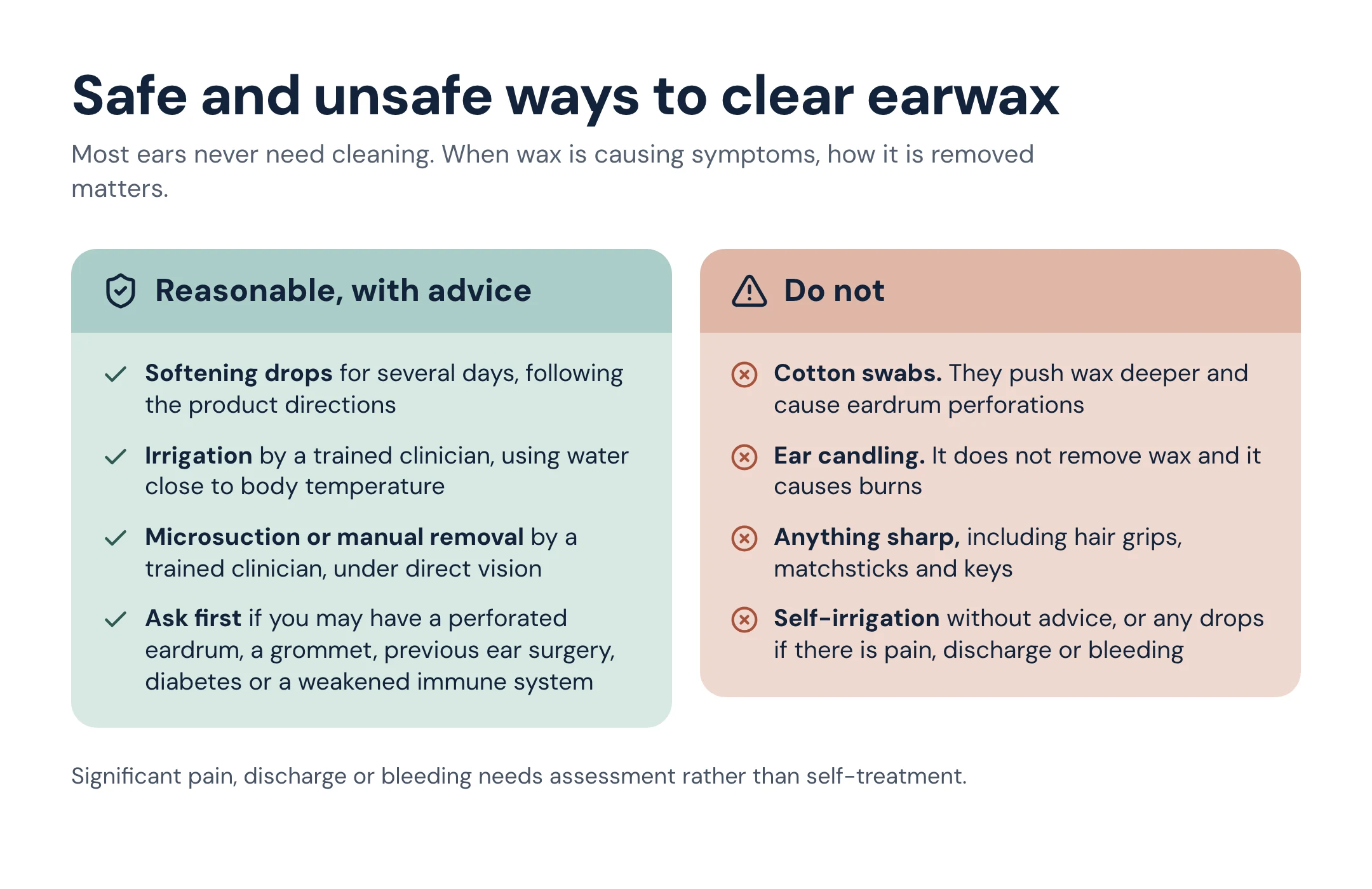
Wax-softening drops are often used before removal, but no high-quality evidence shows that one type is best.
A Cochrane review found low-quality evidence and could not determine whether oil-based, water-based, saline or commercial drops differed meaningfully.[2] That does not prove that plain water or saline is equally effective. Follow the product directions and ask a pharmacist or clinician which option is suitable for you.
Drops. A clinician or pharmacist may recommend a wax-softening product for several days. Do not put drops into an ear if you may have a perforated eardrum, a tube or grommet, previous ear surgery, or active pain or discharge, unless a clinician has said it is safe.[4]
Irrigation. A trained clinician may flush the canal with water close to body temperature after checking that irrigation is suitable. It is not safe for every ear.
Microsuction or manual removal. A trained clinician removes the wax under direct vision. Temporary pain, noise discomfort or dizziness can occur. In one survey of 159 patients, average symptom ratings were mild, and prior softening drops were associated with less pain and vertigo.[3]
Ask a clinician before treatment if you have diabetes, a weakened immune system, take blood-thinning medication, have had head or neck radiotherapy, have a narrow ear canal, or may have a perforated eardrum, grommet or previous ear surgery.[4] Seek assessment rather than self-treatment if there is significant pain, discharge or bleeding.
What should you never put in your ear?
Do not put anything into the ear canal to clean it, and cotton swabs least of all.
Cotton swabs. These can push wax deeper and injure the ear canal or eardrum. In a US study of children treated in emergency departments for cotton-swab ear injuries, ear cleaning was the most common circumstance; foreign-body sensation, perforated eardrum and soft-tissue injury were the most common diagnoses.[5] An adult case series also documented cotton-swab-related eardrum perforations.[6]
Ear candling. A hollow candle is lit near the ear on the claim it draws wax out. The US earwax guideline recommends against it, and it causes burns.[4] Avoid it.
Anything sharp, including hair grips, matchsticks, and keys.
Does removing earwax help tinnitus?
Removing impacted wax should improve the part of any hearing loss caused by the blockage. Its effect on tinnitus is less predictable.
Some people find that tinnitus becomes less noticeable when sound reaches the ear more clearly again. Others notice no change, particularly when there are additional contributors to the tinnitus. The 2024 population study did not test tinnitus before and after wax removal, so it cannot tell us how often removal helps.[1]
If tinnitus continues after the ear is clear, this means wax was not the only explanation. A hearing test can check for hearing loss and guide the next step.
Can tinnitus start after earwax removal?
Tinnitus has been reported after wax-removal procedures, but the evidence cannot tell us how often this happens.
Tinnitus has been reported after wax-removal procedures, particularly when a procedure is painful or is followed by a hearing change or ear injury. The available evidence cannot tell us how often this happens or prove that the procedure caused the tinnitus.
One older study found that 11 of 2,400 people attending a specialist tinnitus clinic attributed the start of their tinnitus to clinician-performed wax removal.[7] This was not 0.5% of all wax-removal procedures: the study included only people who already had tinnitus and relied on retrospective self-report.
If tinnitus starts during or soon after removal, especially with sudden hearing loss, severe pain, discharge, bleeding or marked dizziness, seek medical assessment.
What else causes tinnitus?
Tinnitus is commonly associated with hearing loss, and several other things can contribute.
Tinnitus is commonly associated with hearing loss. Other possible contributors include noise exposure, some medicines, jaw joint problems, and head or neck injury. Stress and poor sleep often make tinnitus more noticeable or harder to manage, even when they are not the original cause.
Our guide to what causes tinnitus goes through these in more detail.
Seek urgent medical care today if tinnitus comes with a sudden drop in hearing, severe vertigo, facial weakness or other new neurological symptoms. Sudden hearing loss needs urgent assessment because treatment is time-sensitive, and it should not be assumed to be wax.[8]
Arrange prompt medical or audiology assessment if the tinnitus pulses with your heartbeat, remains on one side, or occurs with ear pain, discharge or bleeding.
Talk to someone first if you are struggling with your mental health. Suicidal thoughts, severe depression, or a mental health condition that feels unmanageable all mean your primary care provider or a mental health professional is the right first call. Digital tinnitus tools are not the right starting point. You would not be unusual in needing that: a 2025 review of nine studies covering more than 900,000 people found that people with tinnitus were about twice as likely to have experienced suicidal thoughts as people without it.[10]
Oto is intended for adults 18 years and older with chronic, bothersome tinnitus.
What should you do next?
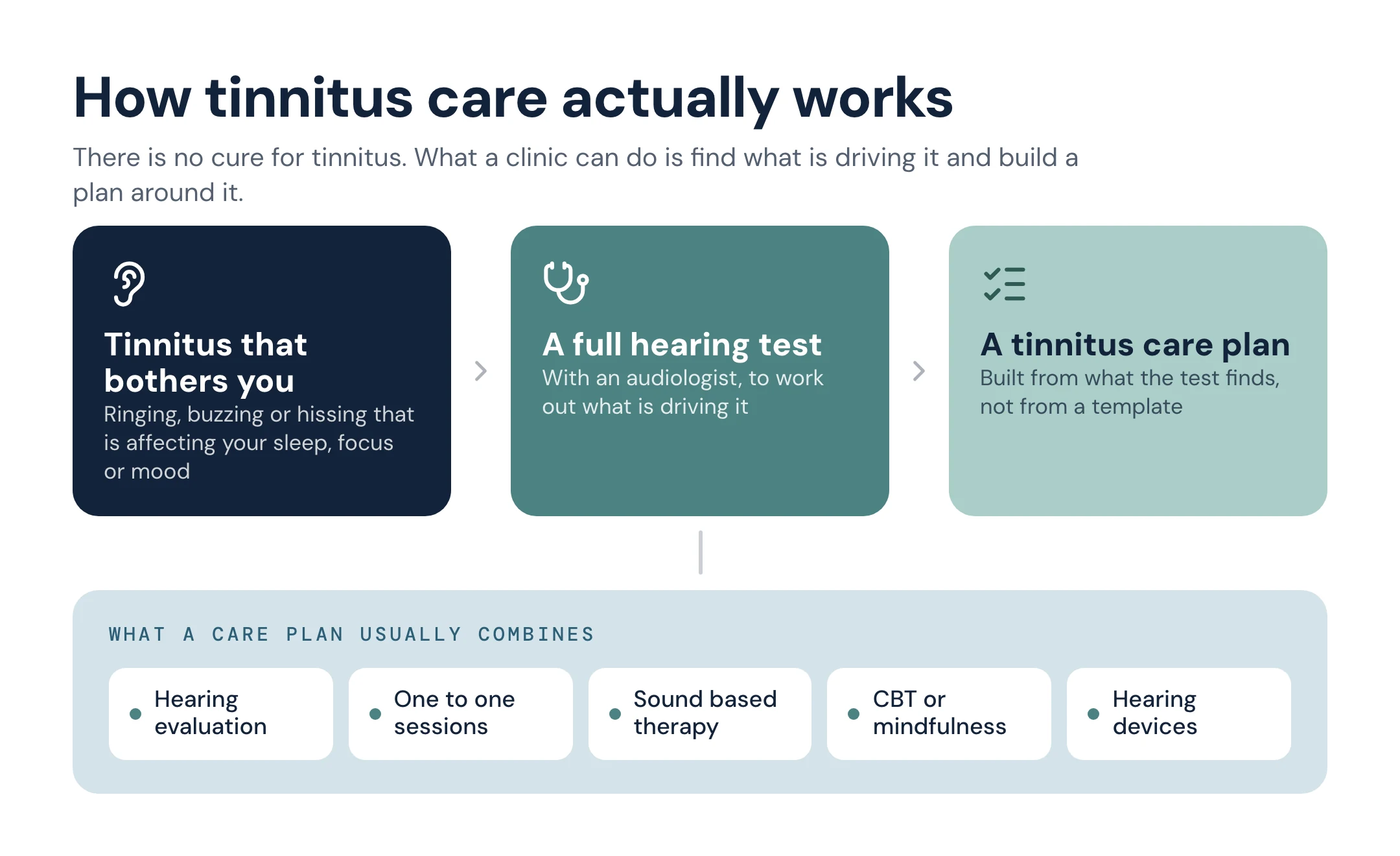
Get the ear looked at first, then get a proper hearing test if the tinnitus continues.
If tinnitus continues after the ear is clear, a hearing assessment is a sensible next step. US guidance recommends prompt comprehensive audiology when tinnitus is persistent, affects one ear, or comes with hearing difficulty; assessment may also be appropriate for other people with tinnitus.[9]
Management depends on the findings. Cognitive behavioral therapy is recommended for persistent, bothersome tinnitus. Hearing aids may help when hearing loss is present, and sound therapy is an option for some people.[9]
A tinnitus care plan from an audiology clinic may include:
- A tinnitus and hearing evaluation, to work out what is contributing
- One-to-one sessions with the audiologist
- Sound-based therapy, which uses sound to make tinnitus less noticeable
- Cognitive behavioral therapy, a talking therapy aimed at the effects of tinnitus rather than the sound itself
- Hearing devices, where hearing loss is part of the picture
- A structured digital program, so you can carry on the daily work between appointments
This is what Oto's associated specialists do. They are audiology clinics across the US that assess tinnitus and hearing and build a plan from what they find. If you want someone to check whether ear wax is the problem, that is the appointment to book.
Oto is one of those digital programs. It holds a sound library, guided audio sessions covering education, mindfulness, relaxation and coping techniques, and structured daily practice, and it was built by a team including doctors and audiologists. In the US, clinics include it in their tinnitus care plan rather than patients buying it on their own.
There is also plenty you can do meanwhile, including ways to sleep better with tinnitus. Many people also find that tinnitus becomes less intrusive over time, although this varies from person to person.
Frequently asked questions
Can earwax cause tinnitus?
Impacted earwax may cause or worsen tinnitus in some people, especially when it reduces hearing. However, tinnitus has many possible contributors, and removing wax does not always stop it. A large US cross-sectional study found no population-level association, but it did not measure symptoms before and after removal.
Will my tinnitus go away after earwax removal?
It may improve if the blockage was contributing, but there is no guarantee. If tinnitus continues once the ear is clear, a hearing test can check for hearing loss and help guide the next step.
How do I know if earwax is causing my symptoms?
A blocked feeling or muffled hearing makes wax more plausible, but an examination is needed to see whether wax is present. Otoscopy can confirm a blockage; it cannot by itself prove that the wax caused the tinnitus.
Can earwax cause dizziness?
Dizziness or vertigo can occur alongside earwax problems or removal, but it has many possible causes. Do not assume wax is responsible, particularly if the dizziness is severe, sudden or persistent.
What is the safest way to remove earwax at home?
Ask a pharmacist or clinician which wax-softening product is suitable and follow its instructions. Do not use drops or irrigation without medical advice if you may have a perforated eardrum, grommet, previous ear surgery, significant pain or discharge, or a condition that increases the risk of complications. Never insert cotton swabs, ear candles or sharp objects into the ear canal.
How often should earwax be removed?
Most people never need it done, because the ear canal is self-cleaning. Removal is for wax that is causing symptoms or stopping a clinician examining the ear.
Does ear candling work?
No. It does not remove wax and it causes burns. Avoid it.
References
- Tolan MM, Choi JS, Tibesar MT, et al. (2024). Cerumen impaction: Prevalence and associated factors in the United States population. Laryngoscope Investigative Otolaryngology. PMID 38525118. doi:10.1002/lio2.1228
- Aaron K, Cooper TE, Warner L, et al. (2018). Ear drops for the removal of ear wax. Cochrane Database of Systematic Reviews. PMID 30043448. doi:10.1002/14651858.CD012171.pub2
- Prowse SJ, Mulla O (2014). Aural microsuction for wax impaction: survey of efficacy and patient perception. The Journal of Laryngology & Otology. PMID 25017385. doi:10.1017/S0022215114000796
- Schwartz SR, Magit AE, Rosenfeld RM, et al. (2017). Clinical Practice Guideline (Update): Earwax (Cerumen Impaction). Otolaryngology–Head and Neck Surgery. PMID 28045591. doi:10.1177/0194599816671491
- Ameen ZS, Chounthirath T, Smith GA, et al. (2017). Pediatric Cotton-Tip Applicator-Related Ear Injury Treated in United States Emergency Departments, 1990-2010. The Journal of Pediatrics. PMID 28473166. doi:10.1016/j.jpeds.2017.03.049
- Smith M, Darrat I, Seidman M (2012). Otologic complications of cotton swab use: one institution's experience. The Laryngoscope, 122(2), 409-411. PMID 22241624. doi:10.1002/lary.22437
- Folmer RL, Shi BY (2004). Chronic tinnitus resulting from cerumen removal procedures. The International Tinnitus Journal. PMID 15379348
- Chandrasekhar SS, Tsai Do BS, Schwartz SR, et al. (2019). Clinical Practice Guideline: Sudden Hearing Loss (Update). Otolaryngology–Head and Neck Surgery. PMID 31369359. doi:10.1177/0194599819859885
- Tunkel DE, Bauer CA, Sun GH, et al. (2014). Clinical practice guideline: tinnitus. Otolaryngology–Head and Neck Surgery. PMID 25273878. doi:10.1177/0194599814545325
- McCray LR, Scharner MK, Nguyen SA, et al. (2025). Suicidal Ideation and Behaviors in Adults With Tinnitus: A Systematic Review and Meta-Analysis. The Laryngoscope. PMID 40066649. doi:10.1002/lary.32118