
In short: Two different things can go away here, and separating them gives you the real answer. The sound itself often stays, if you have had tinnitus for more than six months. Your awareness of the sound usually fades a long way, and for many people it fades almost completely. That second one decides how you actually live, and it is what tinnitus care aims at. Your brain is built to filter out sounds it has decided do not matter. Once it does that with tinnitus, the sound seems quieter, you stop noticing it for long stretches, and it stops upsetting you when you do. That process is called habituation, it is where most people with tinnitus end up, and there is a lot you can do to help it along. If your tinnitus is in one ear only, pulses in time with your heartbeat, or arrived with a sudden drop in hearing, see a doctor promptly.
Does tinnitus go away?
The sound often stays. Your awareness of it usually fades, and that is the change that decides how much tinnitus affects your life.
Tinnitus, the ringing, buzzing or hissing you hear with no sound source in the room, is common. US clinical guidelines put it at 10% to 15% of adults, which is more than 50 million people in the United States.[1] A 2026 review across the research puts it near 14% of adults, with around 2% experiencing severe symptoms.[2]
That second figure is the encouraging one. The large majority of people who have tinnitus are not severely affected by it. Most of them are getting on with their lives, and most of them stopped thinking about it a long time ago.
On the sound itself, the best evidence comes from a 2020 study that followed adults in the general population rather than patients at a clinic. It found that full resolution is relatively uncommon once tinnitus is established, and that over the follow up period improvement and worsening were about equally likely.[3]
Your experience of the sound behaves quite differently, and much better. A study that followed people from the first weeks of their tinnitus found that in those whose tinnitus persisted, the tinnitus itself held steady while how much it affected them improved anyway.[4]
How long does tinnitus last?
Tinnitus under six months may still settle completely. Past six months the sound usually stays, and the improvement you feel comes from your reaction to it changing.
US guidelines define persistent tinnitus as tinnitus lasting six months or longer.[1] You will see other thresholds quoted online, including two weeks and three months. Six months is the figure the American Academy of Otolaryngology uses, and it is the one clinicians work to.
For tinnitus that has only just started, a study that recruited people within four weeks of onset and followed them for six months found nine out of 49, about 18%, had complete resolution.[4] The people who recovered tended to have had it for a shorter time and to be less frightened by loud sound.
| Time since it started | What to expect |
|---|---|
| Days to weeks | Often follows an obvious cause such as loud noise or a cold, and may settle as that resolves |
| Under 6 months | Classed as recent onset. Around one in five people in one small study had complete resolution by 6 months |
| 6 months and beyond | Classed as persistent. The sound usually stays, and how much you notice it can keep improving |
| Years | Most people reach a point where they go days at a time without registering it at all |
My tinnitus suddenly stopped. What happened?
Tinnitus fluctuates, and quiet spells are completely normal. They are also a good sign, because they show your brain is capable of tuning the sound out.
Almost everyone with tinnitus has periods where the ringing fades or disappears, then returns. Sleep, stress, background noise, tiredness and how much attention you are paying all move it.
A quiet morning after a good night's sleep is worth noticing for what it demonstrates. Your tinnitus is not a fixed volume dial. It moves with your state, which means the things that improve your state will move it too.
A lasting disappearance is most likely when two things are true. The tinnitus was recent, and it had a clear temporary cause that has now resolved: a loud concert, a cold or blocked ear, an ear infection, or earwax.
If yours has stopped, protect your hearing, keep your sleep steady, and try to resist checking whether the sound is still there. That checking habit is one of the most reliable ways to bring it back to the front of your mind.
What are the signs tinnitus is going away?
The signs are about how often it shows up and how much it matters, rather than about volume.
- The ringing happens less often, and for shorter stretches
- It sounds softer, or harder to pick out
- You feel less bothered by it, even when you can hear it
- You can sleep, relax and concentrate without it interfering
- You have more good tinnitus days than bad ones
- You go longer without thinking to check whether it is there
That last one is real progress, and it is worth counting as a win. People regularly reach a stage where the sound is technically unchanged and they have simply stopped tracking it. From the inside, that feels like the tinnitus going away, because in every way that affects your day, it has.
Is tinnitus permanent?
Tinnitus lasting more than six months is usually permanent in the sense that the sound remains. How much it affects you stays changeable for years.
There is no cure for tinnitus, and any product promising one is worth avoiding. What is genuinely well established is that the sound and its impact on your life come apart over time, and the impact keeps responding long after the sound has settled into whatever it is going to be.
Permanent tinnitus is most often linked to something structural: hearing loss from age or noise, hearing loss of any kind, damage to the hearing nerve, or a sudden hearing loss event. Tinnitus that comes and goes alongside a temporary cause behaves differently and often clears with it.
Why does tinnitus stop bothering you, even when the sound stays?
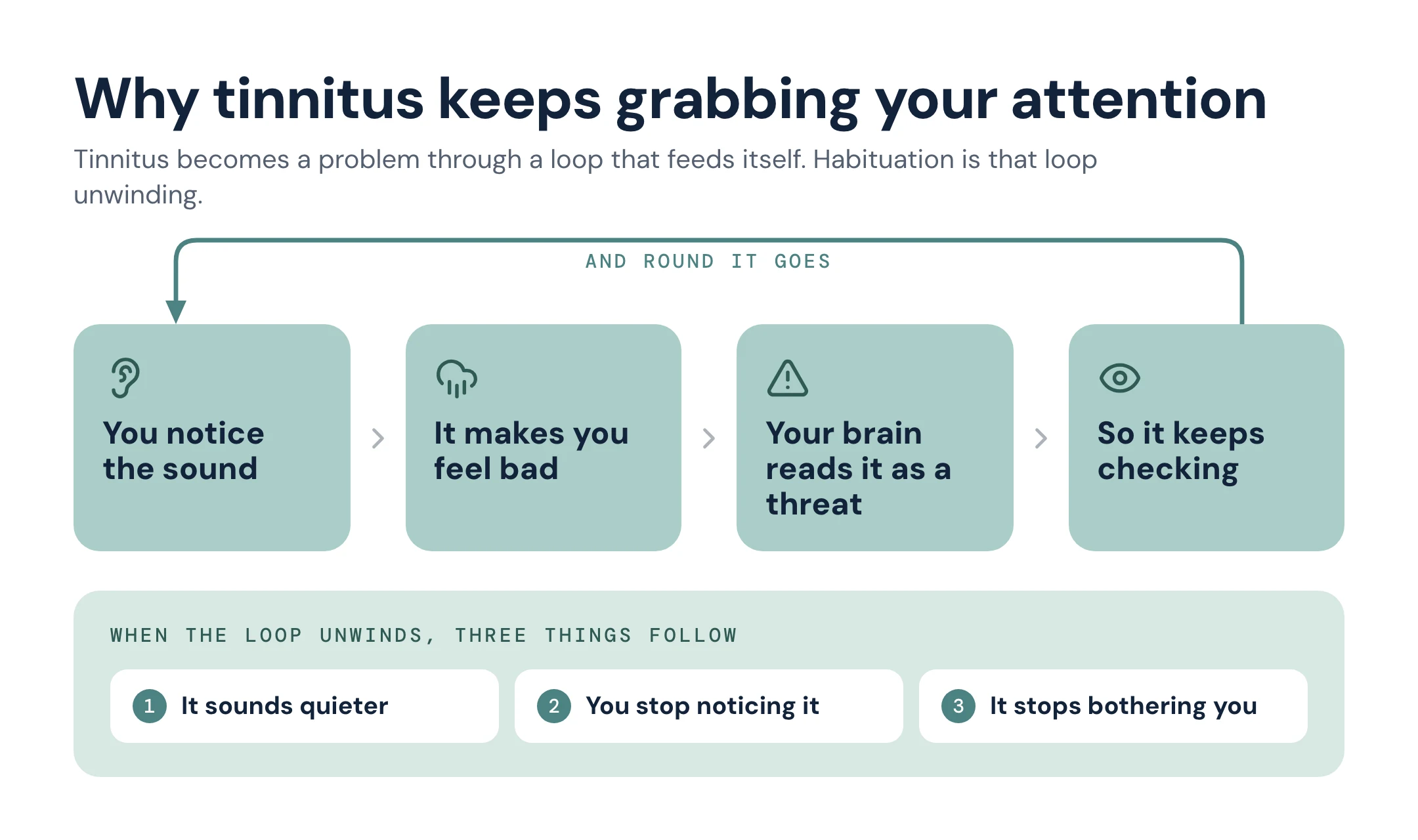
Because your brain can learn the sound is not a threat. Once it learns that, it stops flagging the sound to you, and it fades into the background.
Tinnitus becomes a problem through a loop. You notice the sound. It makes you feel bad. Your brain reads it as something threatening, so it starts checking for it. Each check makes you notice it again, and round it goes. Research into how tinnitus turns distressing describes exactly this pattern, with attention becoming biased toward the sound and the emotional weight attached to it keeping the cycle running.[5]
Habituation is that loop unwinding. As your brain learns the sound carries no threat, it stops checking for it, and three things follow.
| What changes | Why |
|---|---|
| It sounds quieter | Stress raises how loud tinnitus seems. Take the alarm response away and the perceived volume comes down with it |
| You stop noticing it | Your brain stops flagging the sound, so it drops out of your attention for hours or days at a time |
| It stops bothering you | Even when you deliberately listen for it, it no longer sets anything off |
Habituation is a well described process, and the main clinical model behind tinnitus therapy is built directly on it: you habituate your reaction to the sound first, and habituation of the perception follows.[6]
There is a good reason this works even when the tinnitus itself never changes. How loud tinnitus is turns out to be only weakly to moderately related to how disabling people find it. Emotional distress is a much stronger predictor of how much tinnitus takes over someone's life than its volume is.[7] The half that governs your quality of life is therefore the half that responds to treatment, which is a better position to be in than it first sounds.
You can also work at habituation rather than waiting for it. A 2020 Cochrane review, which is an independent summary of the good quality studies on one question, found that cognitive behavioral therapy may be effective in reducing the negative impact tinnitus has on quality of life, while noting the evidence does not extend past six months of follow up.[8] Current US and international guidance both put counseling and cognitive behavioral therapy among the first things to try.[2] [9]
Our guide to tinnitus habituation covers how the process works in practice.
What does living with tinnitus for years actually look like?
For most people it looks like an ordinary life, with the tinnitus somewhere in the background and rarely in the way.
Tinnitus success stories usually get told as sudden recoveries. The commoner and more useful story is somebody whose tinnitus never left and who stopped organizing their life around it.
One person we interviewed, who asked to be called Lulu, has had tinnitus for over 23 years and is fully habituated to it. It began suddenly one night while she was caring for her two young children. Tests found nothing, and she was told she was stuck with it for life without being offered any support or pointed toward anyone else who had it.
"I was back at home, a young mother of 2 kids struggling with tinnitus and thinking that I was the only one in the world who was suffering from this."
She got there anyway, without a program and without anyone guiding her. "It required great mental capacity to first overcome and accept it, but I made slow progress," she says. She raised her two children, and she describes a full social life now, helped by simply telling people.
"I am no longer ashamed to introduce myself to people and add in the statement: by the way, I suffer from tinnitus so could you speak louder. I realise most people are empathetic and compassionate and they do try to accommodate me."
The part she regrets is how long she spent believing she was the only one. It took her around eleven years to start talking about it, and she is clear that she would tell anyone earlier in this to skip that decade: find a therapy that suits you, tell the people around you, get your hearing checked regularly, and find others with tinnitus.
The ending is the part to hold onto. She has had tinnitus for over two decades, she has hearing loss alongside it, and she does not spend her days thinking about either.
What makes tinnitus more or less noticeable?
Tinnitus recedes when you are occupied and there is sound around you, and it comes forward in silence and when you are stressed or tired.
| You will usually notice it less | You will usually notice it more |
|---|---|
| In conversation, or concentrating on listening | In a silent room, especially falling asleep or waking |
| With music, a fan, or sound therapy playing | When you are not occupied by anything |
| When there is ordinary background noise around you | If you have untreated hearing loss |
| Absorbed in something you enjoy | When you are stressed or anxious |
| Well rested, and not under pressure | When you are short of sleep |
| Wearing hearing aids, if you have hearing loss | When you check to see whether it is still there |
Two of these are worth acting on today. Getting your sleep in order moves tinnitus more than most people expect, and treating hearing loss puts ordinary sound back into your day, which covers the tinnitus and takes pressure off your listening at the same time.
When should you see a professional?
Any tinnitus that bothers you is worth a hearing test. A few features need seeing promptly.
See a doctor promptly if your tinnitus:
- Came with a sudden drop in hearing. This is time critical and treated far more successfully when seen within days[10]
- Is in one ear only
- Pulses in time with your heartbeat
- Comes with dizziness, ear pain, or fluid from the ear
Talk to someone first if you are struggling with your mental health. Suicidal thoughts, severe depression, or a mental health condition that feels unmanageable all mean your primary care provider or a mental health professional is the right first call. Digital tinnitus tools are not the right starting point. You would not be unusual in needing that: a 2025 review of nine studies covering more than 900,000 people found that people with tinnitus were about twice as likely to have experienced suicidal thoughts as people without it.[12]
Oto is intended for adults 18 years and older with chronic, bothersome tinnitus.
US primary care guidance recommends a full hearing test with an audiologist for anyone whose tinnitus is one sided, has lasted six months or longer, or comes alongside a change in hearing.[11]
It is also worth asking for help with the things tinnitus drags along with it. Trouble sleeping, anxiety, low mood and difficulty concentrating are all common, all treatable, and all feed the loop that keeps tinnitus in the foreground. Treating them goes straight at the thing that determines how much tinnitus affects you, so it is some of the most productive work available.
What should you do next?
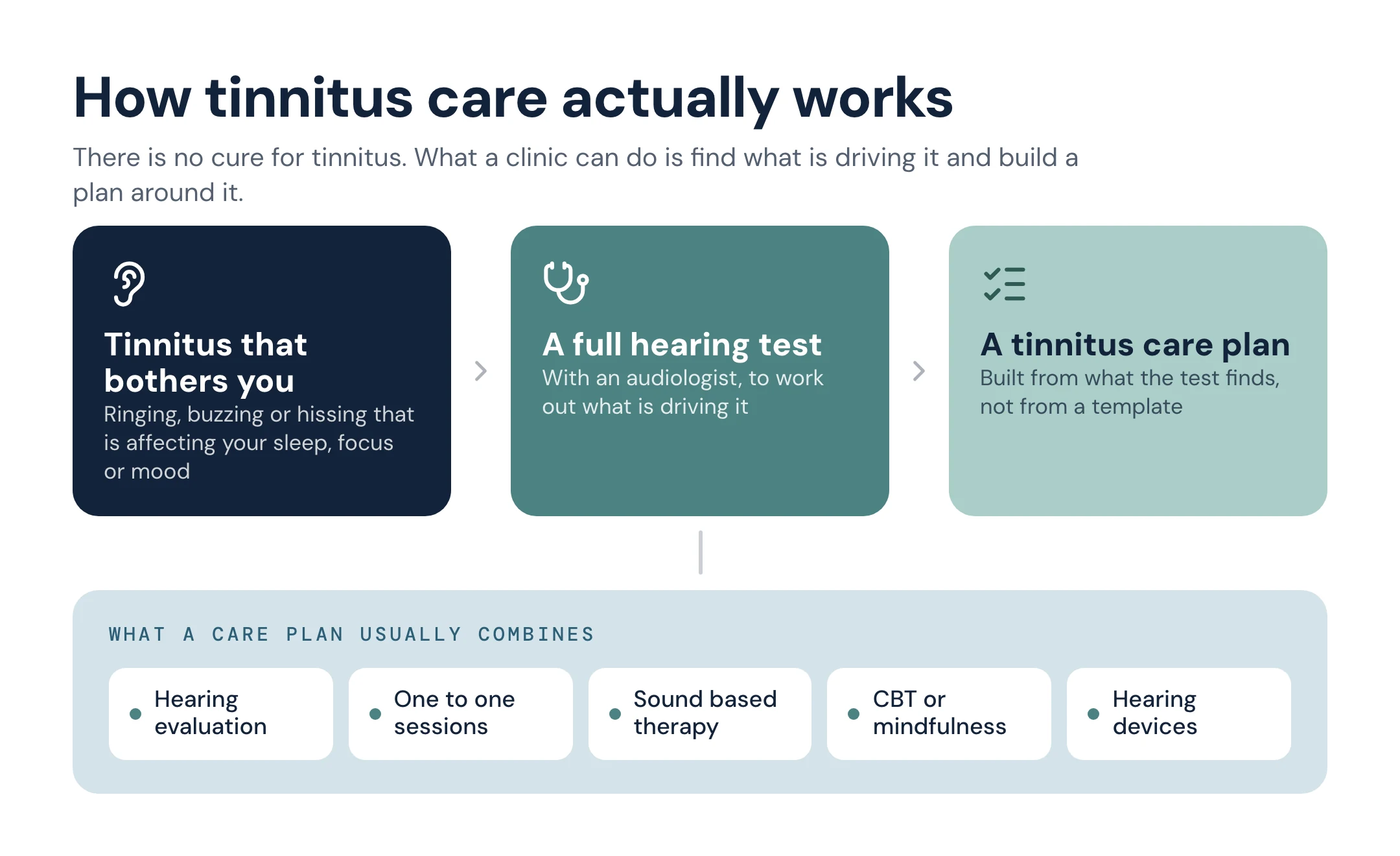
Start with a full hearing test, because what happens next depends entirely on what it finds.
US clinical guidelines recommend that anyone with persistent, bothersome tinnitus has a proper hearing evaluation.[1] It answers the questions this article cannot: whether hearing loss is part of your picture, whether anything treatable is contributing, and what is realistic for you specifically.
A tinnitus care plan from an audiology clinic may include:
- A tinnitus and hearing evaluation, to work out what is contributing
- One-to-one sessions with the audiologist
- Sound based therapy, which uses sound to make tinnitus less noticeable
- Cognitive behavioral therapy, a talking therapy aimed at the reaction to tinnitus rather than at the sound itself
- Hearing devices, where hearing loss is part of the picture
- A structured digital program, so the daily work carries on between appointments
This is what Oto's associated specialists do. They are audiology clinics across the US that assess tinnitus and hearing and build a plan from what they find. If you have been told to go away and live with your tinnitus, that is the appointment that replaces waiting with a plan.
Oto is one of those digital programs. It holds a sound library, guided audio sessions covering education, mindfulness, relaxation and coping techniques, and structured daily practice, and it was built by a team including doctors and audiologists. In the US, clinics include it in a tinnitus care plan rather than patients buying it on their own.
Frequently asked questions
Does tinnitus go away?
Two things can go away, and they behave differently. The sound often stays once tinnitus has lasted more than six months. Your awareness of the sound usually fades a long way, and for many people it fades almost completely, which is the change that decides how much tinnitus affects daily life.
How long does tinnitus last?
It depends on how long you have already had it. Under six months it is classed as recent onset and may still settle; one small study found about 18% resolved fully by six months. Past six months the sound usually stays, while how much you notice it keeps improving.
My tinnitus suddenly stopped. Has it gone for good?
Possibly, and quiet spells are normal either way. Tinnitus moves with sleep, stress and background sound, so gaps of hours or days are common. A lasting disappearance is most likely when the tinnitus was recent and had a clear temporary cause such as a cold, an ear infection or earwax.
Is tinnitus permanent?
Tinnitus lasting more than six months usually is, in the sense that the sound remains. There is no cure. How much it affects you is a separate question, and that keeps improving for years.
Can tinnitus go away after years?
The sound rarely disappears after years. Most people do reach a point where they go days without noticing it, which is what habituation looks like in practice and what it feels like from the inside.
Does tinnitus ever go away on its own, without treatment?
Yes, most often when it is recent and had a clear temporary cause such as loud noise, a cold or earwax. Once tinnitus has lasted six months, the sound going away on its own becomes uncommon, though your awareness of it can keep fading without any formal treatment.
What are the signs tinnitus is going away?
It occurs less often and for shorter periods, feels softer or easier to ignore, stops interfering with sleep and concentration, and you have more good days than bad. Going longer without checking whether it is still there counts as real progress.
Can you live a normal life with tinnitus?
Yes, and most people with tinnitus do. Around 14% of adults have tinnitus and roughly 2% experience severe symptoms, so the large majority are living ordinary lives with it in the background. Habituation is the usual destination rather than the lucky exception.
References
- Tunkel DE, Bauer CA, Sun GH, et al. (2014). Clinical practice guideline: tinnitus. Otolaryngology–Head and Neck Surgery. PMID 25273878. doi:10.1177/0194599814545325
- Vanneste S, De Ridder D, Gallus S, et al. (2026). Tinnitus. Nature Reviews Disease Primers. PMID 42168216. doi:10.1038/s41572-026-00702-0
- Dawes P, Newall J, Stockdale D, et al. (2020). Natural history of tinnitus in adults: a cross-sectional and longitudinal analysis. BMJ Open. PMID 33303456. doi:10.1136/bmjopen-2020-041290
- Vielsmeier V, Santiago Stiel R, Kwok P, et al. (2020). From Acute to Chronic Tinnitus: Pilot Data on Predictors and Progression. Frontiers in Neurology. PMID 33041971. doi:10.3389/fneur.2020.00997
- Ghodratitoostani I, Vaziri Z, Miranda Neto M, et al. (2024). Conceptual framework for tinnitus: a cognitive model in practice. Scientific Reports. PMID 38531913. doi:10.1038/s41598-023-48006-7
- Jastreboff PJ (2007). Tinnitus retraining therapy. Progress in Brain Research. PMID 17956806. doi:10.1016/S0079-6123(07)66040-3
- Sušac T, Čarapina Zovko I, Lesko J, et al. (2026). Psychological Correlates of Tinnitus Handicap: Associations with Personality Traits and Emotional Distress. Journal of Clinical Medicine. PMID 42589900. doi:10.3390/jcm15155796
- Fuller T, Cima R, Langguth B, et al. (2020). Cognitive behavioural therapy for tinnitus. Cochrane Database of Systematic Reviews. PMID 31912887. doi:10.1002/14651858.CD012614.pub2
- Sherlock LP, Ballard-Hernandez J, Boudin-George A, et al. (2025). Clinical Practice Guideline for Management of Tinnitus: Recommendations From the US VA/DOD Clinical Practice Guideline Work Group. JAMA Otolaryngology–Head & Neck Surgery. PMID 40111327. doi:10.1001/jamaoto.2025.0052
- Chandrasekhar SS, Tsai Do BS, Schwartz SR, et al. (2019). Clinical Practice Guideline: Sudden Hearing Loss (Update). Otolaryngology–Head and Neck Surgery. PMID 31369359. doi:10.1177/0194599819859885
- Dalrymple SN, Lewis SH, Philman S (2021). Tinnitus: Diagnosis and Management. American Family Physician. PMID 34060792
- McCray LR, Scharner MK, Nguyen SA, et al. (2025). Suicidal Ideation and Behaviors in Adults With Tinnitus: A Systematic Review and Meta-Analysis. The Laryngoscope. PMID 40066649. doi:10.1002/lary.32118