

In short: No vitamin, mineral, or supplement has been shown to reliably improve tinnitus. The most studied one is ginkgo biloba, and the best review of it could not say whether it helps or not, because the studies were too small and too weakly designed to tell. A few nutrients may help in particular situations, usually where someone is genuinely short of them, or where sleep is the main problem. Below is what the research shows for each one, and how to spot a product that is being sold on a promise it cannot keep.
Do vitamins or supplements help tinnitus?
No supplement has been shown to treat tinnitus, and the evidence for the popular ones is weak.
People search for vitamins for tinnitus more than for almost any other self-help option, so it is worth being direct about what the research supports.
It is worth saying that clearly, because a lot of products are sold on the opposite promise. Tinnitus is common, it can be very hard to live with, and there is no pill that takes it away. That makes people with tinnitus a target for products promising more than they can deliver.
That does not mean every supplement has been tested and failed. For most of them, the research is simply thin. The studies tend to be small, short, and not well designed.
There is a particular reason study quality matters here. Tinnitus is measured by asking people how loud and how troubling their tinnitus feels. Answers to that kind of question move a lot when someone believes they are being treated, even if they are taking a dummy pill. So a weak study can easily look like a positive result.
Before trying anything, it helps to know what is actually causing your tinnitus, because a few causes are treatable in their own right.
One recent study pooled the results of many separate trials of tinnitus treatments. It concluded that antioxidant supplements including ginkgo, along with certain vitamins, "could be promising", while asking for larger and better designed trials before anyone draws conclusions.[1] That gap between promising and proven is where most supplement marketing sits.
What does the research say about each supplement?
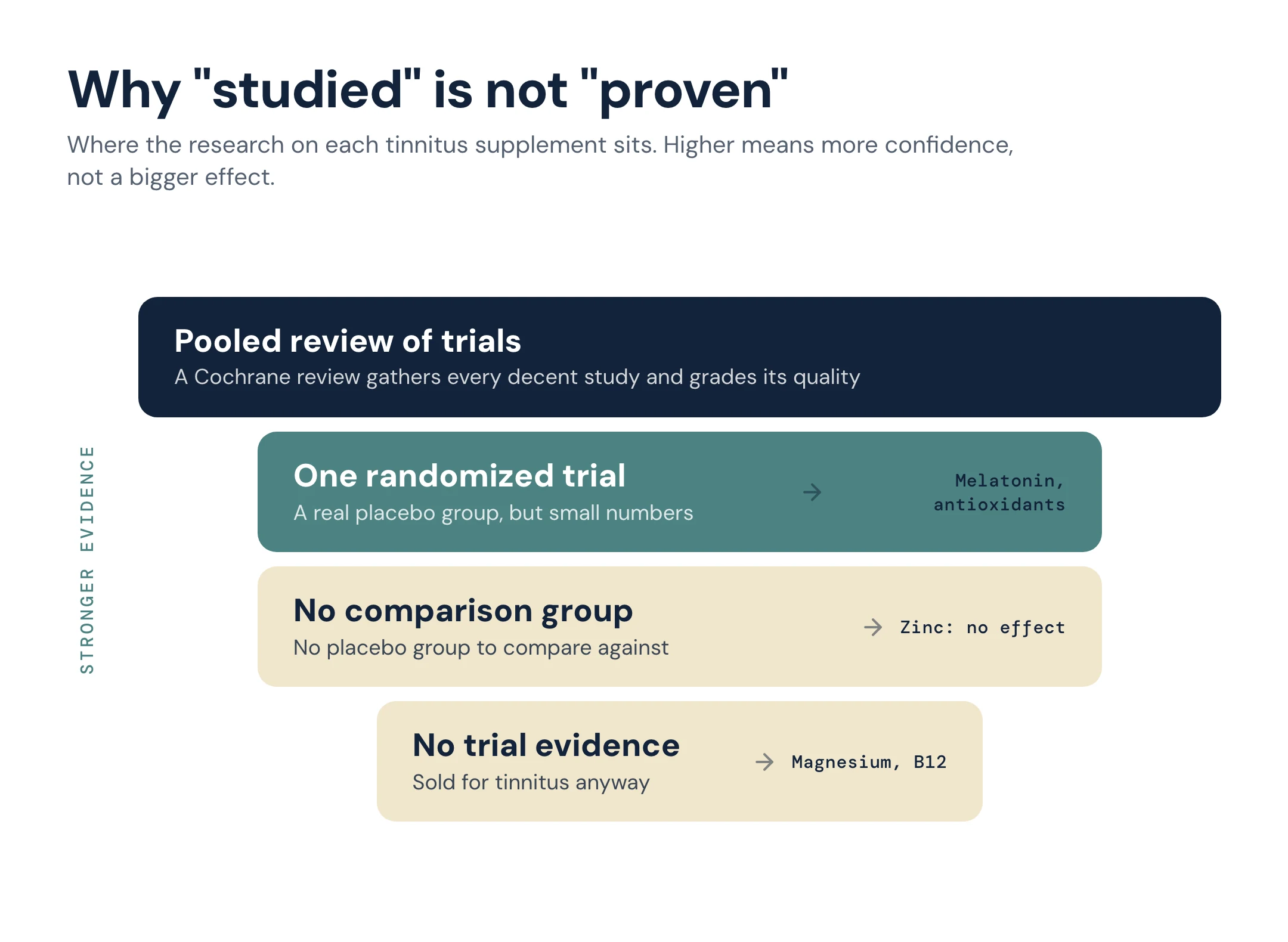
Ginkgo has been studied the most and the answer is still unclear. The others rest on a handful of small studies.
| Supplement | Said to | What the research shows | In practice |
|---|---|---|---|
| Ginkgo biloba | Improve blood flow to the inner ear | A 2022 Cochrane review could not tell whether it helps or harms compared with a dummy pill. The evidence was rated low to very low quality[2] | Most studied, still unproven. Affects blood thinners |
| Melatonin | Quieten tinnitus and help sleep | A randomized placebo-controlled trial of 61 people found a drop in tinnitus intensity and better sleep[3] | The best evidence on this page, and still one small trial. Ask your doctor |
| Zinc | Correct a shortage linked to tinnitus | An uncontrolled study of 40 people found no significant effect on tinnitus after 8 weeks[4] | No good evidence it helps. Worth testing for a shortage if suspected |
| Antioxidant blends | Protect the inner ear from damage | A randomized placebo-controlled trial of 70 people over 3 months found tinnitus loudness fell in the supplement group only[5] | A single small trial. Too early to recommend |
| Magnesium | Protect the inner ear | Only small studies, none repeated at a larger scale | Not enough evidence |
| Vitamin B12 | Correct a shortage causing tinnitus | No trial evidence for tinnitus itself | Get tested before taking it |
Ginkgo biloba
Ginkgo is the most researched supplement for tinnitus, and the best review of it could not reach an answer either way.
The review worth knowing about is a Cochrane review. Cochrane reviews gather all the decent studies on one question and grade how much confidence each one deserves, which makes them among the most trusted sources in medicine.
The 2022 Cochrane review on ginkgo for tinnitus found that it could not tell whether ginkgo helped or harmed compared with a dummy pill, and rated the quality of the evidence as low to very low.[2] The authors asked for better studies, pointing out that tinnitus is judged by the person experiencing it, so a dummy pill often appears to work.
So ginkgo has not been shown to fail. The research just is not good enough yet to say either way.
One safety point. Ginkgo can make bleeding more likely, and it affects blood thinning medicines. Speak to your doctor or pharmacist before taking it if you take any blood thinner, or if you have surgery coming up.
Melatonin
Melatonin has the best evidence of anything on this page, and the clearest benefit is on sleep.
A randomized, double-blind trial gave 61 adults with long term tinnitus either 3mg of melatonin or a dummy pill each night for a month, then swapped the groups over. Tinnitus intensity and sleep quality both improved more on melatonin than on the dummy pill.[3]
The authors also reported larger improvements in some groups, including men, people without a history of depression, and people with more severe or two sided tinnitus. Those are comparisons within a 61 person trial rather than findings the study was designed to test, so treat them as a hint rather than as a reason to expect a particular result yourself.
Sleep is worth taking seriously on its own. Being tired makes tinnitus harder to cope with, and tinnitus makes sleep harder, so anything that breaks that cycle helps even if the sound never changes. There are also practical ways to sleep better with tinnitus that do not involve taking anything.
Melatonin is sold over the counter in the US. Talk to a clinician about dose and timing rather than guessing.
Zinc
Zinc has not been shown to help tinnitus, and the study most often quoted for it found no significant effect.
The study usually cited gave zinc to 40 people with severe tinnitus for 8 weeks. There was no control group, so everyone received zinc. Tinnitus severity did not change significantly, and there was no significant difference between people who started with normal zinc levels and people who started low.[4]
Two other things in that study are worth knowing. It did not find the high rate of zinc deficiency in tinnitus patients that earlier reports had claimed. And the authors noted some relief among older participants who appeared to be short of zinc in their diet, which is an observation in a small uncontrolled study rather than a result you can rely on.
So zinc is worth attention if you may be deficient, and that is a blood test and a conversation with your doctor rather than a tinnitus treatment.
Magnesium, vitamin B12, and the others
For the rest, the studies are small, few, and nobody has repeated them at a larger scale.
Magnesium and vitamin B12 both turn up in tinnitus supplement marketing, and so do riboflavin (vitamin B2), vitamin C, and general multivitamins. Plenty of products are sold for hearing loss and tinnitus together. None of them has trial evidence showing an effect on tinnitus. Where a nutrient does help someone, the straightforward explanation is that they were short of it, and correcting a shortage is a different thing from treating tinnitus.
The same principle covers all of them. If you are short of a nutrient, the answer is a test and treatment from your doctor. Taking a supplement without knowing whether you are short of anything is guesswork, and some nutrients cause harm in large doses.
How can you spot a tinnitus supplement scam?
Any product promising to cure tinnitus is making a claim no evidence supports, and that promise is the clearest warning sign there is.
There is a difference between a nutrient with thin evidence behind it and a product built on a false promise. Ginkgo is the first kind. Products sold with names hinting at silence or a cure are usually the second.
In the US, the Federal Trade Commission requires health claims on supplements to be backed by solid scientific evidence.[6] A product claiming to cure, reverse, or get rid of tinnitus is claiming something nobody has shown.
Signs worth watching for:
- The word cure, or promises to "eliminate" or "reverse" tinnitus
- A claim that doctors or hearing aid companies are hiding the product
- Personal stories and dramatic before and after claims instead of published research
- A subscription that is hard to cancel
- A "proprietary blend" that does not say how much of each ingredient you get
- Countdown timers, low stock warnings, and pressure to buy now
These products are also expensive. Many are sold as a monthly subscription that is hard to cancel, and they cost far more than the same ingredients bought separately. People buy them because they are struggling and want something to try.
What actually helps tinnitus?
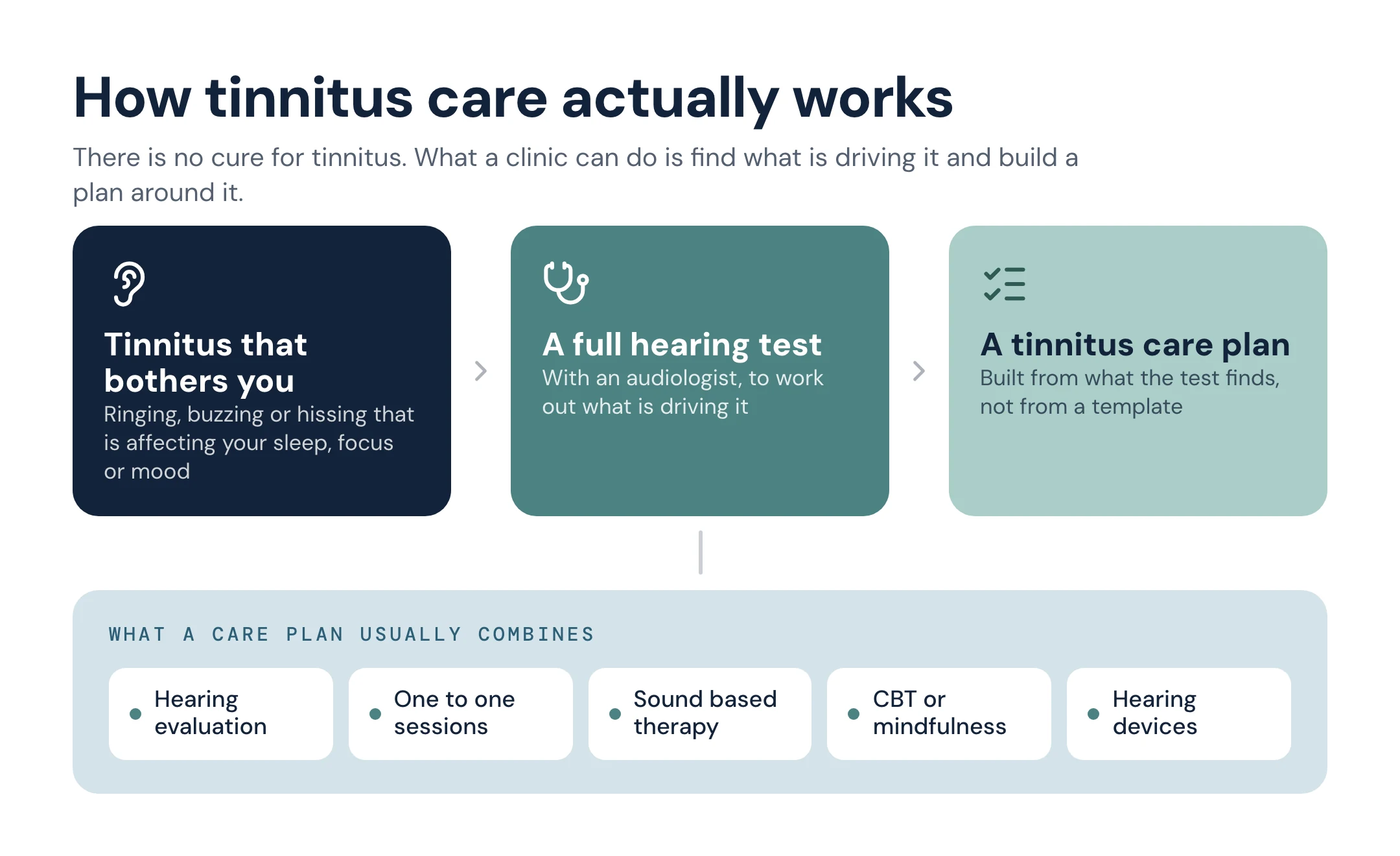
The first step is a full hearing test with an audiologist, who can then build a plan around what is actually causing your tinnitus.
US clinical guidelines recommend that anyone with ongoing, troubling tinnitus has a full hearing test with an audiologist.[7] [8] That is more than a formality. Hearing loss often sits alongside tinnitus and can be treated, and the test rules out causes that need attention of their own.
What happens next depends on what the test finds. A tinnitus care plan from an audiology clinic may include:
- A tinnitus and hearing evaluation, to work out what is contributing
- One-to-one sessions with the audiologist
- Sound based therapy, which uses sound to make tinnitus less noticeable
- Cognitive behavioral therapy, a talking therapy aimed at the distress tinnitus causes rather than the sound itself
- Hearing devices, where hearing loss is part of the picture
- A structured digital program, so you can carry on the daily work between appointments
This is what Oto's associated specialists do. They are audiology clinics across the US that assess hearing and tinnitus and build a plan from what they find. If you have been reaching for supplements because nobody has properly assessed you yet, that is the appointment worth booking.
Oto is one of those digital programs. It holds a sound library, guided audio sessions covering education, mindfulness, relaxation and coping techniques, and structured daily practice, and it was built by a team including doctors and audiologists. In the US, clinics include it in their tinnitus care plan rather than patients buying it on their own.
See a doctor promptly, instead of trying supplements, if your tinnitus:
- Is in one ear only
- Pulses in time with your heartbeat
- Started suddenly, or came with a sudden drop in hearing
- Comes with dizziness, ear pain, or discharge from the ear
A sudden drop in hearing needs urgent attention. It is treated far more successfully when it is seen quickly.[9]
Talk to someone first if you are struggling with your mental health. Suicidal thoughts, severe depression, or a mental health condition that feels unmanageable all mean your primary care provider or a mental health professional is the right first call. Digital tinnitus tools are not the right starting point. You would not be unusual in needing that: a 2025 review of nine studies covering more than 900,000 people found that people with tinnitus were about twice as likely to have experienced suicidal thoughts as people without it.[10]
Oto is intended for adults 18 years and older with chronic, bothersome tinnitus.
For the fuller picture of what is available, see our guide to tinnitus treatments.
Frequently asked questions
What is the best vitamin for tinnitus?
There is no best vitamin for tinnitus, because none has been shown to reliably improve it. If a blood test shows you are short of something, correcting that is worth doing for your general health.
Can a vitamin deficiency cause tinnitus?
Being short of some nutrients, including vitamin B12, has been linked with tinnitus. A link is not the same as a cause. If you think you might be short of something, ask your doctor for a blood test rather than taking supplements on spec.
Does ginkgo biloba work for tinnitus?
Nobody knows. The most careful review of it, from Cochrane in 2022, could not tell whether it helped or harmed, and rated the evidence low to very low quality.[2] Ginkgo also affects blood thinning medicines, so check with your doctor first.
Are tinnitus supplements safe?
Not always. Supplements face lighter rules than medicines in the US, the amount you actually get varies between products, and some affect prescription medicines. Ginkgo affects bleeding. Several nutrients cause harm in large doses.
Why are there so many tinnitus supplement ads?
Tinnitus is common and distressing, there is no cure, and a supplement can be sold without proving it works. That combination makes people with tinnitus an easy market.
Should I stop taking something my doctor recommended?
No. This page is about supplements sold directly for tinnitus. If your doctor has recommended something for a diagnosed shortage or another condition, keep following their advice.
References
- Li P, Che C, Wu Y, et al. (2025). Pharmacotherapy options for the management of subjective tinnitus: a systematic review and network meta-analysis. BMJ Open. PMID 40441764. doi:10.1136/bmjopen-2024-096995
- Sereda M, Xia J, Scutt P, et al. (2022). Ginkgo biloba for tinnitus. Cochrane Database of Systematic Reviews. PMID 36383762. doi:10.1002/14651858.CD013514.pub2
- Miroddi M, Bruno R, Galletti F, et al. (2011). Melatonin: can it stop the ringing? Annals of Otology, Rhinology & Laryngology. PMID 21859051
- Yetiser S, Tosun F, Satar B, et al. (2002). The role of zinc in management of tinnitus. Auris Nasus Larynx. PMID 12393036
- Petridou AI, Zagora ET, Petridis P, et al. (2019). The Effect of Antioxidant Supplementation in Patients with Tinnitus and Normal Hearing or Hearing Loss: A Randomized, Double-Blind, Placebo Controlled Trial. Nutrients. PMID 31842394
- Federal Trade Commission. Health Products Compliance Guidance (2022). ftc.gov/business-guidance/resources/health-products-compliance-guidance
- Tunkel DE, Bauer CA, Sun GH, et al. (2014). Clinical practice guideline: tinnitus. Otolaryngology–Head and Neck Surgery. PMID 25273878. doi:10.1177/0194599814545325
- Sherlock LP, Ballard-Hernandez J, Boudin-George A, et al. (2025). Clinical Practice Guideline for Management of Tinnitus: Recommendations From the US VA/DOD Clinical Practice Guideline Work Group. JAMA Otolaryngology–Head & Neck Surgery. PMID 40111327. doi:10.1001/jamaoto.2025.0052
- Chandrasekhar SS, Tsai Do BS, Schwartz SR, et al. (2019). Clinical Practice Guideline: Sudden Hearing Loss (Update). Otolaryngology–Head and Neck Surgery. PMID 31369359. doi:10.1177/0194599819859885
- McCray LR, Scharner MK, Nguyen SA, et al. (2025). Suicidal Ideation and Behaviors in Adults With Tinnitus: A Systematic Review and Meta-Analysis. The Laryngoscope. PMID 40066649. doi:10.1002/lary.32118