
In short: Tinnitus can begin or become more noticeable during a cold. Congestion can temporarily affect the eustachian tubes and the pressure behind the eardrums, particularly if your ears also feel blocked, pop or have muffled hearing. This may improve as the illness settles, but there is no reliable timetable and a cold should not automatically be assumed to explain every new hearing symptom. Seek urgent medical care for a sudden drop in hearing. Pulsatile tinnitus, persistent tinnitus in one ear, significant ear pain or discharge, and ongoing dizziness also need assessment.
Can a cold cause tinnitus?
A cold can coincide with new or more noticeable tinnitus, often alongside pressure or hearing symptoms.
Each middle ear is connected to the back of the nose by a eustachian tube. The tubes normally open intermittently to regulate pressure and help clear the middle ear. Inflammation and congestion during a respiratory infection can temporarily interfere with this function. The result may be fullness, popping, discomfort or muffled hearing, and tinnitus may become more noticeable when less outside sound is reaching the ear.
Timing alone does not prove that congestion is the cause, and research has not established how often this explains tinnitus after a cold.
Why does a cold make your ears ring?
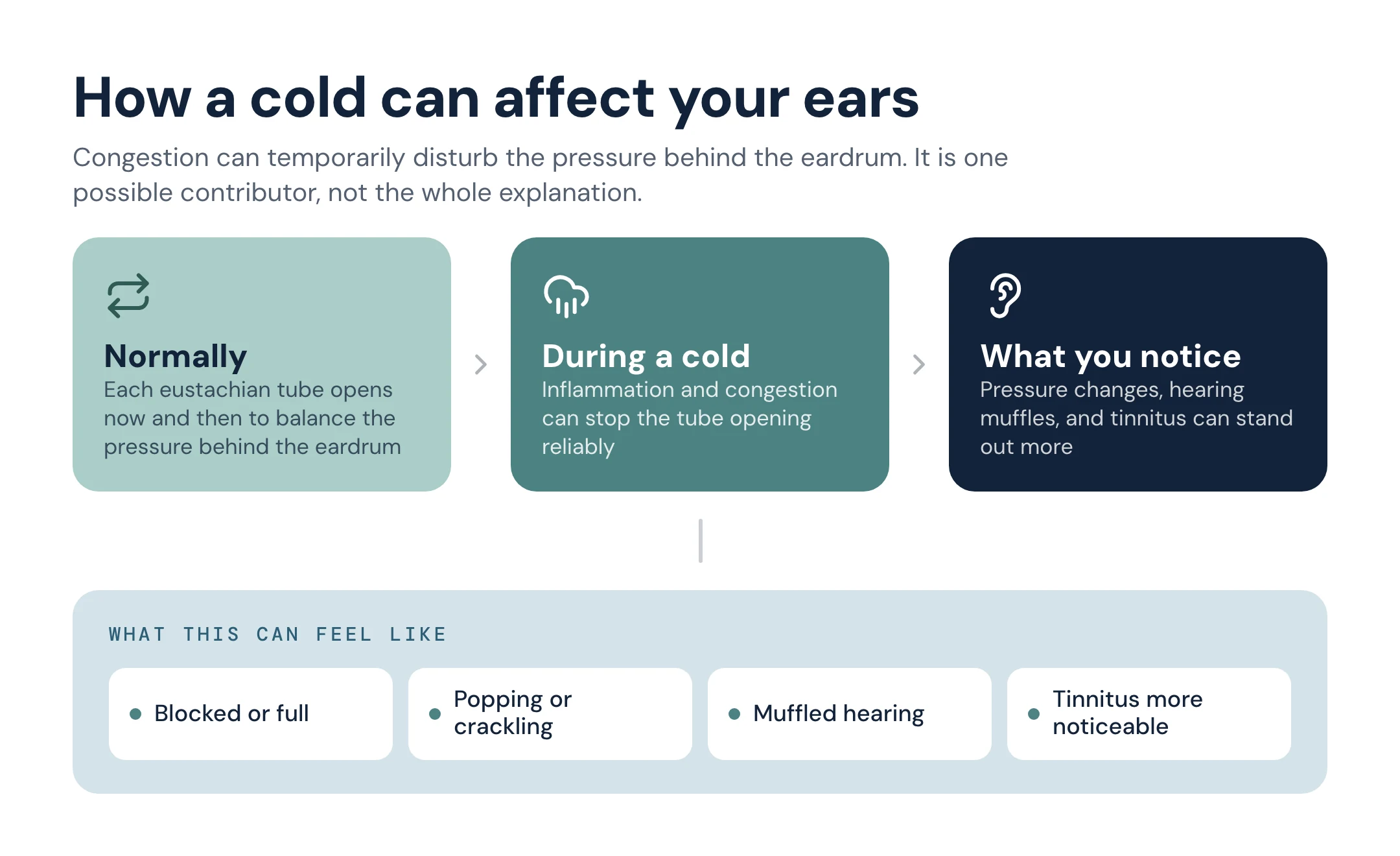
Congestion can temporarily disturb the pressure behind the eardrum, and tinnitus may stand out more when hearing is muffled.
Each eustachian tube is a narrow channel running from a middle ear down to the back of the nose and throat. It is the main route for ventilation, pressure regulation and clearance, and you feel it working when your ears pop on a plane.
A study that followed 86 uncomplicated colds in children, mostly aged 5 to 12, found temporary abnormal middle-ear pressure during 66% of the illnesses.[1] This supports the pressure mechanism, but it did not study adults and it did not measure tinnitus. It therefore cannot tell us how often eustachian-tube dysfunction explains tinnitus after an adult cold. The pressure changes it found were also intermittent, and could shift from one ear to the other from day to day, rather than a tube simply swelling shut for the duration.
People commonly notice some combination of the following during a cold:
| What you feel | What is happening |
|---|---|
| Ears blocked or underwater | Middle-ear pressure may have changed |
| Muffled hearing | The eardrum cannot vibrate freely, so less sound gets through |
| Ringing, buzzing or hissing | Tinnitus may become more noticeable when hearing is muffled, but pressure is not the only possible explanation |
| Popping or crackling | The tube opening and closing against the pressure difference |
Fullness, popping and muffled hearing make a middle-ear contribution more plausible. Symptoms alone cannot confirm it. An ear examination, a hearing test and sometimes tympanometry, which measures how the eardrum moves, can help distinguish a pressure or fluid problem from an inner-ear hearing problem.
Eustachian tube problems also happen outside colds, alongside chronic congestion of any kind. If your ears do this every winter, or every allergy season, that pattern is worth mentioning to a clinician. Our guide to allergies and tinnitus covers the allergy version of the same mechanism, and flying with tinnitus covers the pressure version.
Can a sinus infection cause tinnitus?
Nasal and sinus inflammation can occur with ear pressure symptoms, but the evidence is stronger for chronic sinus disease than for tinnitus after an acute infection.
A cold usually causes viral rhinosinusitis. US guidance considers a bacterial sinus infection more likely when symptoms fail to improve for at least 10 days, or worsen again after initially improving.[5] Antibiotics do not treat viral illness, and uncomplicated bacterial sinusitis can often be managed initially with watchful waiting under appropriate follow-up.[5]
People with chronic rhinosinusitis, meaning symptoms lasting at least twelve weeks, frequently report ear symptoms, particularly fullness and pressure associated with eustachian tube dysfunction. Reviews have reported any ear symptom in up to 87% of them,[2] but that figure is not the prevalence of tinnitus and should not be read as such. A study of 101 patients found that ear symptom scores correlated poorly with how severe the sinuses looked on a CT scan or at endoscopy,[3] so the two do not track each other.
If tinnitus accompanies persistent sinus symptoms, blocked hearing or ear pressure, an examination can check the ear and how the middle ear is working. Sinus surgery is a treatment for appropriately selected chronic sinus disease,[4] not a tinnitus treatment.
Can an ear infection cause tinnitus?
Middle-ear fluid or infection can affect hearing and may be accompanied by tinnitus.
Fluid can collect behind the eardrum without an acute infection, which is called otitis media with effusion. Acute otitis media is diagnosed when there are signs of acute middle-ear inflammation or infection. Either can cause a temporary conductive hearing loss, which may make tinnitus more noticeable.
Evidence about tinnitus with middle-ear fluid is limited, and much of it comes from children. US guidelines on middle-ear fluid, written mainly about children, are built around the fact that most of it clears on its own without any treatment.[6] We cover this in more detail in tinnitus after an ear infection.
Seek medical assessment for significant ear pain, discharge, persistent fever or worsening illness. A sudden drop in hearing requires urgent assessment even if it happens during a cold.
Can cold and flu medicines make tinnitus worse?
There is no good evidence that a short course of correctly dosed over-the-counter cold or pain medicine commonly causes lasting tinnitus.
Medicines that can affect hearing are described as ototoxic. Ototoxic medicines can adversely affect hearing or balance, and the effect and its reversibility depend on the medicine, the dose and the individual.[7] Most of the well known ones are given in hospital.
A large study that followed 69,455 women over many years found that frequent use of NSAID painkillers, such as ibuprofen and naproxen, and frequent use of acetaminophen were each associated with a modestly higher risk of persistent tinnitus.[8] This was long-term observational evidence rather than a study of a few doses during a cold. The reason people were taking the painkillers was not known, both the use and the tinnitus were self-reported, men were not studied, and it could not prove that the medicines caused the tinnitus.
Very high doses of aspirin are a recognized cause of temporary tinnitus, which settles once the dose comes down.[9] This is different from low-dose aspirin prescribed for cardiovascular protection. Do not stop prescribed aspirin or any other medicine without medical advice.
If tinnitus starts or clearly worsens soon after beginning any medicine, check the label and speak to a pharmacist or prescriber. Seek urgent care if it comes with sudden hearing loss or other acute neurological symptoms.
Why does tinnitus feel worse when you are sick?
Being ill disrupts sleep, raises stress and leaves you resting in quiet rooms, and each of those can make tinnitus feel more intrusive.
Being ill can disrupt sleep, increase stress and leave more time resting in quiet surroundings. Each of these can make tinnitus feel more intrusive. This can happen whether or not the pitch or loudness has also changed.
Sleep and stress respond to different things than a blocked ear does. Sleeping better with tinnitus and managing stress are both worth attention while you wait for the congestion to clear.
How long does tinnitus last after a cold?
There is no reliable timetable for tinnitus after a cold.
If tinnitus is related to congestion, pressure or temporary conductive hearing loss, it may improve as those symptoms settle. Ear pressure or middle-ear fluid can sometimes last longer than the nasal symptoms.[6] Research does not provide a dependable "normal" number of days or weeks for the tinnitus itself.
Arrange a hearing assessment if tinnitus persists after the illness, if your hearing has not returned to normal, or if the tinnitus is troublesome.[10] Do not wait if the hearing change was sudden. Persistent tinnitus in one ear also warrants prompt assessment. Many people find that tinnitus becomes less intrusive over time, although this varies from person to person.
How do you stop ringing in ears from a cold?
No treatment has been shown to switch off tinnitus caused by a cold. The practical aim is to manage the respiratory symptoms safely and make the tinnitus less intrusive while the ear recovers or is assessed.
A systematic review of treatments for eustachian tube problems in adults could not recommend any particular one, because the studies were too few and too weak to tell.[11] A 2024 meta-analysis also found no significant benefit from intranasal corticosteroid sprays on eardrum measurements in eustachian tube dysfunction.[14]
- Swallow, yawn or sip water if the ear feels pressured. These are gentle ways to encourage the eustachian tube to open.
- Do not force the ear to pop. A very gentle pressure-equalizing maneuver may help some people, but stop if it causes pain or dizziness. The evidence for autoinflation mainly concerns children with persistent middle-ear fluid, was of low or very low certainty, and ear pain occurred in 4.4% of children who did it against 1.3% of controls.[12] It does not prove benefit for adult post-cold tinnitus.
- Treat nasal symptoms appropriately. Current US sinusitis guidance says analgesics, nasal saline and topical nasal steroids may be considered for relief of viral rhinosinusitis symptoms.[5] They have not been shown to cure tinnitus or reliably normalize eustachian tube function. Ask a pharmacist if you have other health conditions or take other medicines, and follow the product directions.
- Use low-level background sound if quiet makes the tinnitus more intrusive. A fan, a radio at low volume or a sound machine works. Keep the volume comfortable rather than trying to drown the tinnitus out.
- Protect sleep and rest. These can reduce the burden of tinnitus while you recover.
- Leave the ear canal alone. Do not insert cotton swabs or other objects, and do not use ear candles.
Products claiming to cure tinnitus are not supported by good evidence.
When should you see a doctor about tinnitus after a cold?
Some symptoms need to be seen today, and others need prompt assessment rather than waiting.
Seek urgent medical care today if you have:
- A sudden drop or marked change in hearing in one or both ears
- Severe vertigo, facial weakness or another new neurological symptom
- Severe ear pain, swelling behind the ear, or serious systemic illness
Sudden sensorineural hearing loss can feel like a blocked ear and may occur with tinnitus. Assessment and treatment are time-sensitive, so do not assume congestion is the cause.[13]
Arrange prompt medical or audiology assessment if:
- Tinnitus pulses in time with your heartbeat
- Tinnitus remains in one ear
- Dizziness persists or recurs
- There is ear discharge, ongoing pain or fever
- Tinnitus or hearing difficulty continues after the cold has settled
Talk to someone first if you are struggling with your mental health. Suicidal thoughts, severe depression, or a mental health condition that feels unmanageable all mean your primary care provider or a mental health professional is the right first call. Digital tinnitus tools are not the right starting point. You would not be unusual in needing that: a 2025 review of nine studies covering more than 900,000 people found that people with tinnitus were about twice as likely to have experienced suicidal thoughts as people without it.[16]
Oto is intended for adults 18 years and older with chronic, bothersome tinnitus.
What should you do next?
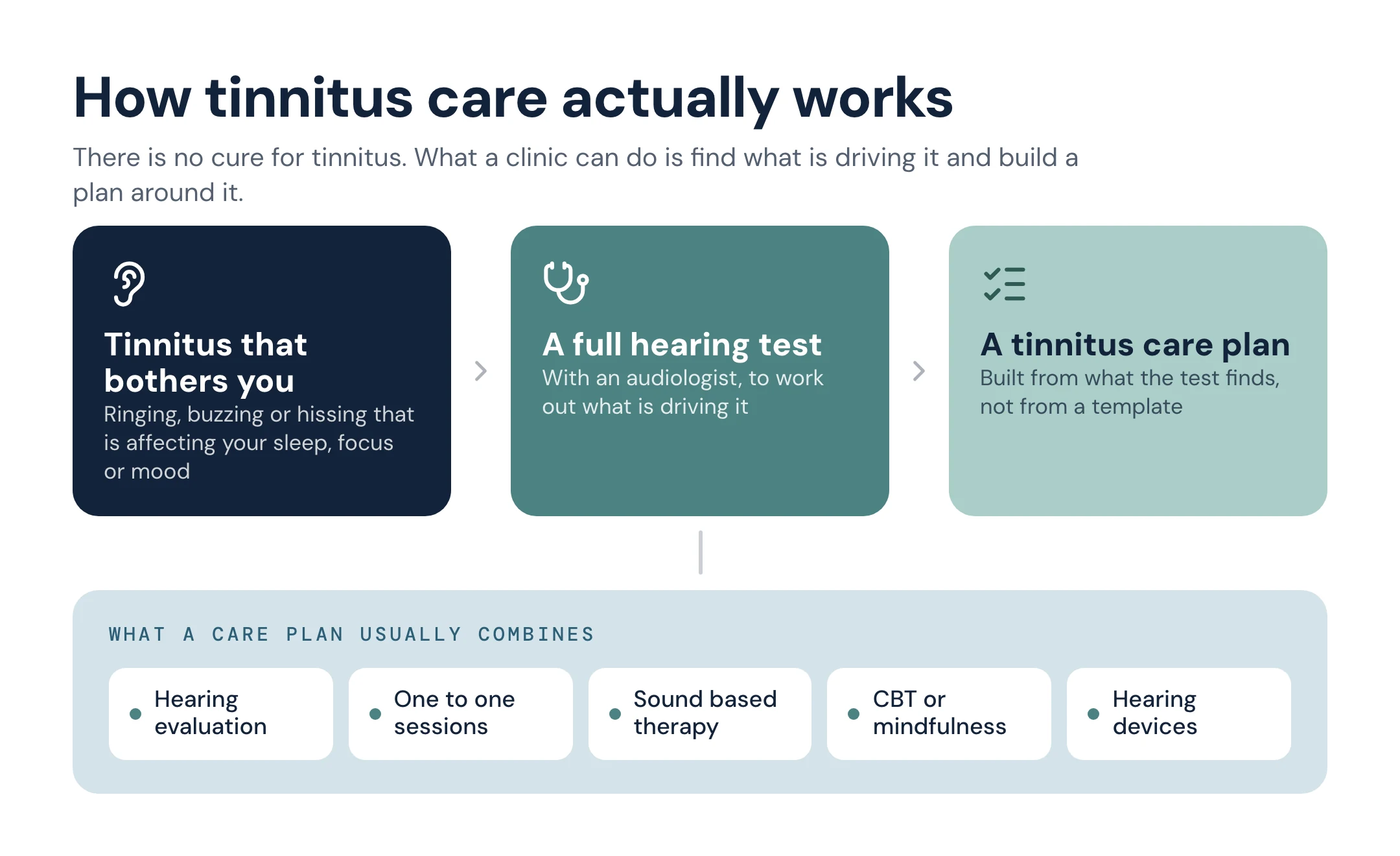
If the tinnitus outlasts the cold, the next step is a full hearing test with an audiologist.
If tinnitus or hearing difficulty continues after the illness, assessment may include an examination of the ear, a hearing test and, when middle-ear pressure or fluid is suspected, tympanometry. US tinnitus guidance recommends prompt comprehensive audiology when tinnitus is persistent, affects one ear, or comes with hearing difficulty; assessment can also be appropriate for other people with tinnitus.[15]
Management depends on what is found. Cognitive behavioral therapy is recommended for persistent, bothersome tinnitus.[15] Hearing aids may help when hearing loss is present, while sound therapy is an option for some people. These approaches manage the effects of tinnitus; they are not treatments for a cold.
A tinnitus care plan from an audiology clinic may include:
- A tinnitus and hearing evaluation, to work out what is contributing
- One-to-one sessions with the audiologist
- Sound-based therapy, which uses sound to make tinnitus less noticeable
- Cognitive behavioral therapy, a talking therapy aimed at the effects of tinnitus rather than at the sound itself
- Hearing devices, where hearing loss is part of the picture
- A structured digital program, so the daily work carries on between appointments
This is what Oto's associated specialists do. They are audiology clinics across the US that assess tinnitus and hearing and build a plan from what they find. If your ears have been ringing since a cold and you want to know whether anything is still going on in there, that is the appointment to book.
Oto is one of those digital programs. It holds a sound library, guided audio sessions covering education, mindfulness, relaxation and coping techniques, and structured daily practice, and it was built by a team including doctors and audiologists. In the US, clinics include it in a tinnitus care plan rather than patients buying it on their own.
Frequently asked questions
Can a cold cause tinnitus?
Tinnitus can start or become more noticeable during a cold. Congestion can temporarily affect middle-ear pressure, especially if the ear also feels blocked, pops or has muffled hearing. However, timing alone does not prove that the cold caused the tinnitus.
Can a sinus infection cause tinnitus?
Nasal and sinus inflammation can occur with eustachian tube and ear pressure symptoms, which may make tinnitus more noticeable. The evidence is stronger for broad ear symptoms in chronic sinus disease than for tinnitus after an acute sinus infection.
How long does tinnitus last after a cold?
There is no reliable timetable. If congestion or temporary middle-ear hearing loss is contributing, tinnitus may improve as those problems settle. Arrange a hearing assessment if it persists, if hearing does not return to normal, or if it is troublesome. Seek urgent care for a sudden drop in hearing.
How do you stop ringing in your ears from a cold?
No treatment has been shown to switch it off. Manage the cold safely, use comfortable background sound if helpful, protect sleep, and avoid forcefully popping or poking the ears. Treatments for nasal symptoms have not been shown to cure tinnitus.
Why does tinnitus feel worse when I am sick?
Congestion may muffle outside sound, while poor sleep, stress and quiet surroundings can make tinnitus more intrusive. More than one factor may be involved, and the tinnitus may feel more intrusive even without an obvious change in pitch or loudness.
Can a head cold cause ringing in one ear?
One ear can feel more blocked than the other during a cold, but new or persistent one-sided tinnitus should not automatically be attributed to congestion. Arrange an assessment, particularly if hearing has changed.
Can flu or COVID cause tinnitus too?
Tinnitus can begin or worsen around many illnesses, including flu and COVID. Congestion may contribute, but it is not the only possible explanation and the evidence for COVID-related tinnitus is more complex. We cover it in tinnitus and COVID. Seek urgent assessment for sudden hearing loss or severe neurological or balance symptoms.
References
- Winther B, Hayden FG, Arruda E, et al. (2002). Viral respiratory infection in schoolchildren: effects on middle ear pressure. Pediatrics. PMID 11986442. doi:10.1542/peds.109.5.826
- Calvo-Henriquez C, Di Corso E, Alobid I, et al. (2023). Pathophysiological Link Between Chronic Rhinosinusitis and Ear Disease. Current Allergy and Asthma Reports. PMID 37395977. doi:10.1007/s11882-023-01072-3
- Tangbumrungtham N, Patel VS, Thamboo A, et al. (2018). The prevalence of Eustachian tube dysfunction symptoms in patients with chronic rhinosinusitis. International Forum of Allergy & Rhinology. PMID 29227048. doi:10.1002/alr.22056
- Teo NW, Mace JC, Smith TL, et al. (2017). Impact of endoscopic sinus surgery on otologic symptoms associated with chronic rhinosinusitis. World Journal of Otorhinolaryngology–Head and Neck Surgery. PMID 28990012. doi:10.1016/j.wjorl.2017.03.001
- Payne SC, McKenna M, Buckley J, et al. (2025). Clinical Practice Guideline: Adult Sinusitis Update. Otolaryngology–Head and Neck Surgery. PMID 40742114. doi:10.1002/ohn.1344
- Rosenfeld RM, Shin JJ, Schwartz SR, et al. (2016). Clinical Practice Guideline: Otitis Media with Effusion (Update). Otolaryngology–Head and Neck Surgery. PMID 26832942. doi:10.1177/0194599815623467
- Campbell KCM, Le Prell CG (2018). Drug-Induced Ototoxicity: Diagnosis and Monitoring. Drug Safety. PMID 29404977. doi:10.1007/s40264-017-0629-8
- Curhan SG, Glicksman J, Wang M, et al. (2022). Longitudinal Study of Analgesic Use and Risk of Incident Persistent Tinnitus. Journal of General Internal Medicine. PMID 35132561. doi:10.1007/s11606-021-07349-5
- Sheppard A, Hayes SH, Chen GD, et al. (2014). Review of salicylate-induced hearing loss, neurotoxicity, tinnitus and neuropathophysiology. Acta Otorhinolaryngologica Italica. PMID 24843217
- Dalrymple SN, Lewis SH, Philman S (2021). Tinnitus: Diagnosis and Management. American Family Physician. PMID 34060792
- Llewellyn A, Norman G, Harden M, et al. (2014). Interventions for adult Eustachian tube dysfunction: a systematic review. Health Technology Assessment. PMID 25029951. doi:10.3310/hta18460
- Webster KE, Mulvaney CA, Galbraith K, et al. (2023). Autoinflation for otitis media with effusion in children. Cochrane Database of Systematic Reviews. doi:10.1002/14651858.CD015253.pub2
- Chandrasekhar SS, Tsai Do BS, Schwartz SR, et al. (2019). Clinical Practice Guideline: Sudden Hearing Loss (Update). Otolaryngology–Head and Neck Surgery. PMID 31369359. doi:10.1177/0194599819859885
- Nibhanupudy TJ, Patel A, Trinh CP, et al. (2024). Efficacy of intranasal corticosteroid sprays for eustachian tube dysfunction: systematic review and meta-analysis. The Journal of Laryngology & Otology. PMID 38682673. doi:10.1017/S0022215124000771
- Tunkel DE, Bauer CA, Sun GH, et al. (2014). Clinical practice guideline: tinnitus. Otolaryngology–Head and Neck Surgery. PMID 25273878. doi:10.1177/0194599814545325
- McCray LR, Scharner MK, Nguyen SA, et al. (2025). Suicidal Ideation and Behaviors in Adults With Tinnitus: A Systematic Review and Meta-Analysis. The Laryngoscope. PMID 40066649. doi:10.1002/lary.32118