

In short: Meditation for tinnitus works on your reaction to the sound, and your reaction is the part that decides how much tinnitus affects your life. Two randomized trials found that mindfulness training reduced how severe people's tinnitus felt, and in both trials it did better than relaxation training. A US study of an eight week mindfulness course found the same drop in tinnitus severity alongside measurable changes in the brain networks that direct attention. The research is still small and mostly short term, so the fair expectation is that the ringing in your ears matters less to you, while the sound carries on. The instinct most people follow, which is to fight the sound or cover it up, is linked in research to tinnitus interfering with life more. If your tinnitus is in one ear only, pulses in time with your heartbeat, or arrived with a sudden drop in hearing, see a doctor promptly.
Does meditation help tinnitus?
Yes, for how much tinnitus bothers you. Several studies have found that people's tinnitus severity scores fall after a mindfulness course, and two randomized trials found mindfulness did better than relaxation training. No study has shown that meditation makes the sound itself go away.
The best summary of the research on meditation and tinnitus is a 2019 systematic review, which is a formal search for every decent study on one question. It pooled seven studies of mindfulness based programs covering 425 people with tinnitus. Six of the seven found that tinnitus distress scores dropped straight after the course, and two of the three randomized trials found drops large enough to matter in real life. The authors concluded that mindfulness may have a place in tinnitus therapy, and that the long term effects still need studying.[1]
Four studies carry most of that weight. The first three were in the review, and the last was published after it.
| Study | What it tested | What it found |
|---|---|---|
| McKenna 2017, randomized trial, 75 adults[2] | Eight weekly two hour sessions of mindfulness based cognitive therapy, against eight weekly sessions of intensive relaxation training | Both groups improved on tinnitus severity and loudness, anxiety, depression and disability. Mindfulness reduced tinnitus severity more, and the difference was still there six months later |
| Arif 2017, randomized trial, 86 recruited[3] | Five sessions of mindfulness meditation, against five sessions of relaxation therapy | Both groups improved. The improvement was larger in the mindfulness group |
| Roland 2015, pilot study, 13 adults[4] | An eight week mindfulness based stress reduction course at Washington University in St Louis | Tinnitus questionnaire scores fell by a meaningful amount, and brain scans showed increased connection strength in attention networks. No comparison group |
| Gans 2023, review of records, 43 adults[5] | An eight week online mindfulness based tinnitus stress reduction course | Average scores moved from the severe range to the moderate range, and the gain held at six months. No comparison group |
Two things keep this modest. The studies are small, and a 2022 review of this whole family of therapies across hearing conditions concluded there is not yet enough evidence to recommend them generally, while noting there is some evidence they help tinnitus distress in the short term.[8] The benefit that shows up consistently is also narrower than the way meditation usually gets sold: the 2019 review found reduced tinnitus distress across the studies and no clear effect on anxiety or depression in people with tinnitus.[1]
What does meditation change, and what does it not?
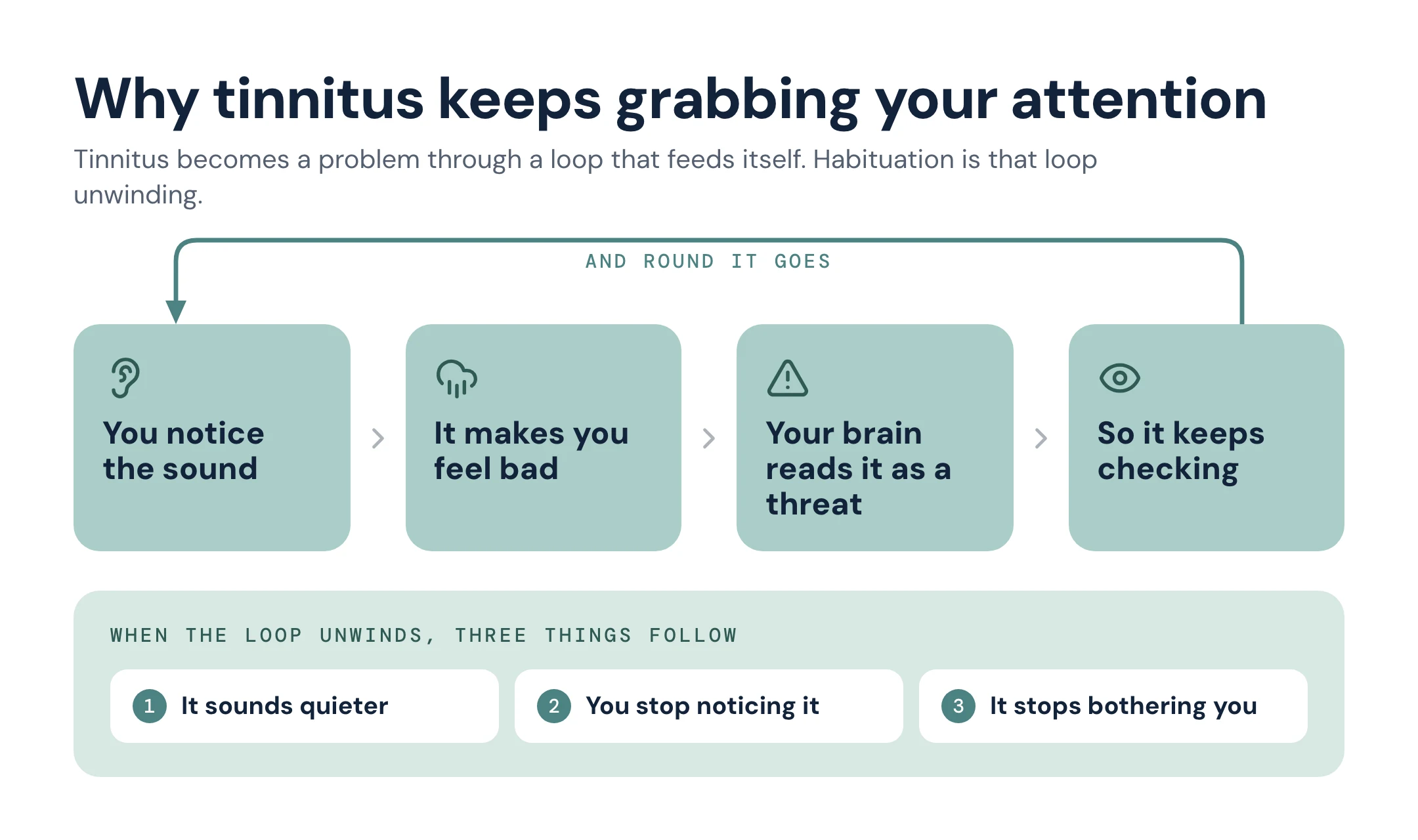
It changes how your brain treats the sound. Whatever is generating the ringing in your ears carries on doing it, and people often report the sound seeming quieter anyway, because stress raises how loud tinnitus seems.
Tinnitus becomes a problem through a loop. You notice the sound, it makes you feel bad, your brain reads it as something threatening, so it starts checking for it. Each check brings it back to your attention, and round it goes.
Meditation acts on the middle of that loop, at the step where your brain decides the sound is worth an alarm. The sound still arrives, and you are still allowed to dislike it. What changes is how much of an emergency your brain makes of it.
As that step relaxes, three things follow, and they are worth separating because people expect only the first one:
- It can sound quieter. Stress raises perceived loudness, so taking the alarm response out often brings the volume down with it. In McKenna's trial, tinnitus loudness ratings fell in both groups.[2]
- You stop noticing it. Your brain stops flagging the sound, and it drops out of your attention for hours or days at a time.
- It stops bothering you. Even when you deliberately listen for it, it no longer sets anything off.
That process is called habituation, and the main clinical model behind tinnitus therapy is built on it: you habituate your reaction to the sound first, and habituation of the perception follows.[9] Our guide to tinnitus habituation covers the process in full, and how tinnitus changes over time covers what to expect from the sound itself.
Why does fighting tinnitus make it worse?
Because the effort of pushing the sound away keeps your attention on it, and studies link that pattern to tinnitus interfering with life more.
Most people meet tinnitus by trying to get rid of it. That is a reasonable first response and it is also the part that tends to backfire.
A small experiment tested this directly. Thirty five people with troublesome tinnitus were randomly split into two groups. One group could adjust the background sound around them, and the other had no control over it. Over a series of trials, the people who could control the sound reported their tinnitus interfering more, and they improved more slowly on a concentration task, than the people who could not.[6]
Researchers then interviewed people who had completed a mindfulness based course for tinnitus, to find out what actually changed for them. Every participant described a different relationship with the sound, and they described it in the same terms: they had stopped fighting it and started allowing it to be there. One of them gave the study its title, saying they were no longer at war with the noise. The practices that asked them to turn their attention toward sound, including their own tinnitus, were the hardest part of the course and the part they said was essential.[5]
Most advice points the other way, toward distraction. A tinnitus meditation practice asks you to spend a few minutes in the company of the sound instead, which is a different job from relaxing with it playing in the background.
How do you meditate when you have tinnitus?
Start with two minutes of slow breathing, then practice paying deliberate attention to something specific. Four exercises are set out below, and the first one uses your tinnitus itself.
Meditation is a set of techniques for training attention. Mindfulness is one form of it: noticing what is happening right now, including things you do not enjoy, without trying to fix or judge them. It came into Western healthcare from Buddhist practice and is now taught as an ordinary skill, in the same way as physiotherapy exercises. Tinnitus mindfulness is that same skill applied to the ringing in your ears.
Meditating with tinnitus has one obstacle the standard instructions ignore. Most beginner guides tell you to find a quiet room, and quiet is exactly where tinnitus stands out most. The exercises below are written with that in mind.
Begin every practice the same way. Sit comfortably. Breathe in slowly through your nose for a count of five, then out gently through your mouth for a count of seven. Do that four or five times. Closing your eyes helps some people and unsettles others, so try both.
Expect your mind to wander. Noticing that it has wandered and coming back is the exercise working, and it does not mean you are doing it wrong.
1. Listening to your tinnitus on purpose
This is the exercise that is specific to tinnitus, and it is the one people find hardest. Deliberately turning toward the sound is a core part of the mindfulness courses that have been studied.[5] Try it when your tinnitus is present but not at its worst.
- Breathe in for five and out for seven, four times
- Let your attention find the tinnitus, without adjusting anything and without trying to make it stop
- Describe it to yourself as though describing weather. Is it high or low? Steady or pulsing? In one ear, both, or somewhere in the middle of your head?
- Notice where you feel it in your body. Many people find their jaw, shoulders or stomach tighten. Let them soften if they will
- Notice what your mind says about the sound. Thoughts like "this is unbearable" or "it is louder today" are commentary, and you can hear them without following them
- Come back to the breath, then finish
A bit of discomfort at the start is normal, and it usually eases with practice. If the exercise reliably leaves you upset, stop and raise it with an audiologist, who can take you through it at a slower pace.
2. The five senses check in
A quick way to pull attention out of a thought loop about tinnitus. It works anywhere and takes about three minutes.
- Breathe in for five and out for seven
- Name five things you can see. Take them one at a time. What color, shape and texture is each one?
- Name four things you can touch. Your hands, the chair, the wall. Warm or cool? Rough or smooth?
- Name three things you can hear. If your tinnitus is one of them, count it and move on
- Name two things you can smell
- Name one thing you can taste
- Finish with one more slow breath
3. Eating mindfully
Most of us eat while doing something else. This exercise uses a single mouthful to practice attention, and it is a useful reset in the middle of a bad tinnitus day.
- Breathe in for five and out for seven
- Look at the food. Notice its color, texture and size
- Pick it up. Is it heavy, light, smooth, rough?
- Smell it before you eat it, and notice how your body responds
- Put it in your mouth and chew slowly. Sour, sweet, bitter, creamy? Can you describe it?
- Notice the swallow, and follow the sensation as far down as you can
- Take one more slow breath before the next bite
4. Walking mindfully
Useful if sitting still makes your tinnitus more obvious, which is common.
- Sit down first and breathe in for five, out for seven
- Stand up slowly, and notice your weight moving from the chair into your feet
- Start walking. Feel the muscles in your legs working
- Notice your weight shifting from one foot to the other
- Check your arms and shoulders. Are they swinging, or held?
- Check your jaw and neck. Tense, or loose?
- Come to a natural stop, and notice how you feel before you finish
None of these needs an app, a class or any equipment. If you would rather be talked through it, guided meditation for tinnitus is widely available in audio and video form, and searching for tinnitus meditation will bring up a great deal of it. Our review of tinnitus apps covers what the main ones contain.
Should you meditate in silence or with background sound?
A little steady background sound is fine and helps most people get started. Constantly adjusting sound to keep the tinnitus out of earshot is the pattern research links to more interference.
Silence makes tinnitus stand out, so a completely quiet room is a hard place to begin. A fan, a quiet piece of music or sound therapy set at a level where you can still hear your tinnitus underneath gives you somewhere comfortable to practice.
What separates the two is what you are using the sound for. Sound you set once and then leave alone is background. Sound you keep reaching for, turning up whenever the tinnitus surfaces, is avoidance, and that is the behavior the experiment above associates with tinnitus getting more intrusive over time.[6]
So start with gentle background sound, and over a few weeks let it get quieter as sitting with the tinnitus gets easier.
Which kind of meditation has been studied for tinnitus?
Three structured mindfulness programs have been tested in people with tinnitus: MBCT, MBSR and MBTSR. Ordinary guided meditation has never been tested on its own, so it is worth trying and there is nothing to quote about how well it works.
| Approach | What it is | Evidence in tinnitus |
|---|---|---|
| Mindfulness based cognitive therapy (MBCT) | An eight week group course combining mindfulness practice with cognitive therapy, usually led by a psychologist | The strongest single trial, where it beat intensive relaxation training and held that lead at six months[2] |
| Mindfulness based stress reduction (MBSR) | The original eight week secular mindfulness course, taught for stress and chronic conditions generally | One small US pilot found reduced tinnitus severity and changes in attention networks in the brain[4] |
| Mindfulness based tinnitus stress reduction (MBTSR) | An eight week tinnitus mindfulness course adapted specifically for the condition, available in person and online | One study of 43 people found average tinnitus scores moved from severe to moderate and held for six months, with no comparison group[5] [7] |
| Relaxation training | Progressive muscle relaxation and breathing, aimed at lowering physical tension | Genuinely helpful, and mindfulness outperformed it in both head to head trials[2] [3] |
| Guided meditation and meditation apps | Recorded sessions you follow at home | Not tested as its own treatment for tinnitus. Reasonable to try, and no basis for claiming a specific effect |
A third randomized study explains why mindfulness kept beating relaxation in the other two. It found that the gains from mindfulness training were kept or grew over the follow up period, while the gains from relaxation faded away.[17] Relaxation gives you relief for as long as the session lasts, and mindfulness teaches a skill you take into the rest of the day.
How long does meditation take to help tinnitus?
The courses that have been tested run for eight weeks with daily practice at home. People in them started reporting change within about three weeks.
Every trial of meditation with tinnitus has used the same shape: eight weeks, one session a week, and short daily practice in between.[2] [4] [5] In the online MBTSR study, average tinnitus scores had already fallen substantially by the three week mark, and the authors suggested a shorter course might work.[5]
Follow up in these studies rarely goes past six months, so nobody can tell you what meditation does for tinnitus over years.[1] And every one of them was a supported course with a teacher, so starting on your own from a web page is a reasonable experiment that has not itself been tested.
Sleep is often the most urgent problem tinnitus causes, and the evidence there is mixed. A review of 18 trials found mindfulness meditation improved sleep quality compared with other activities that took up a similar amount of time, and found no difference from established sleep treatments, though that second comparison rested on weaker evidence.[14] If sleep is your main problem, our guide to sleeping with tinnitus is the better place to start.
Where does meditation fit into tinnitus treatment?
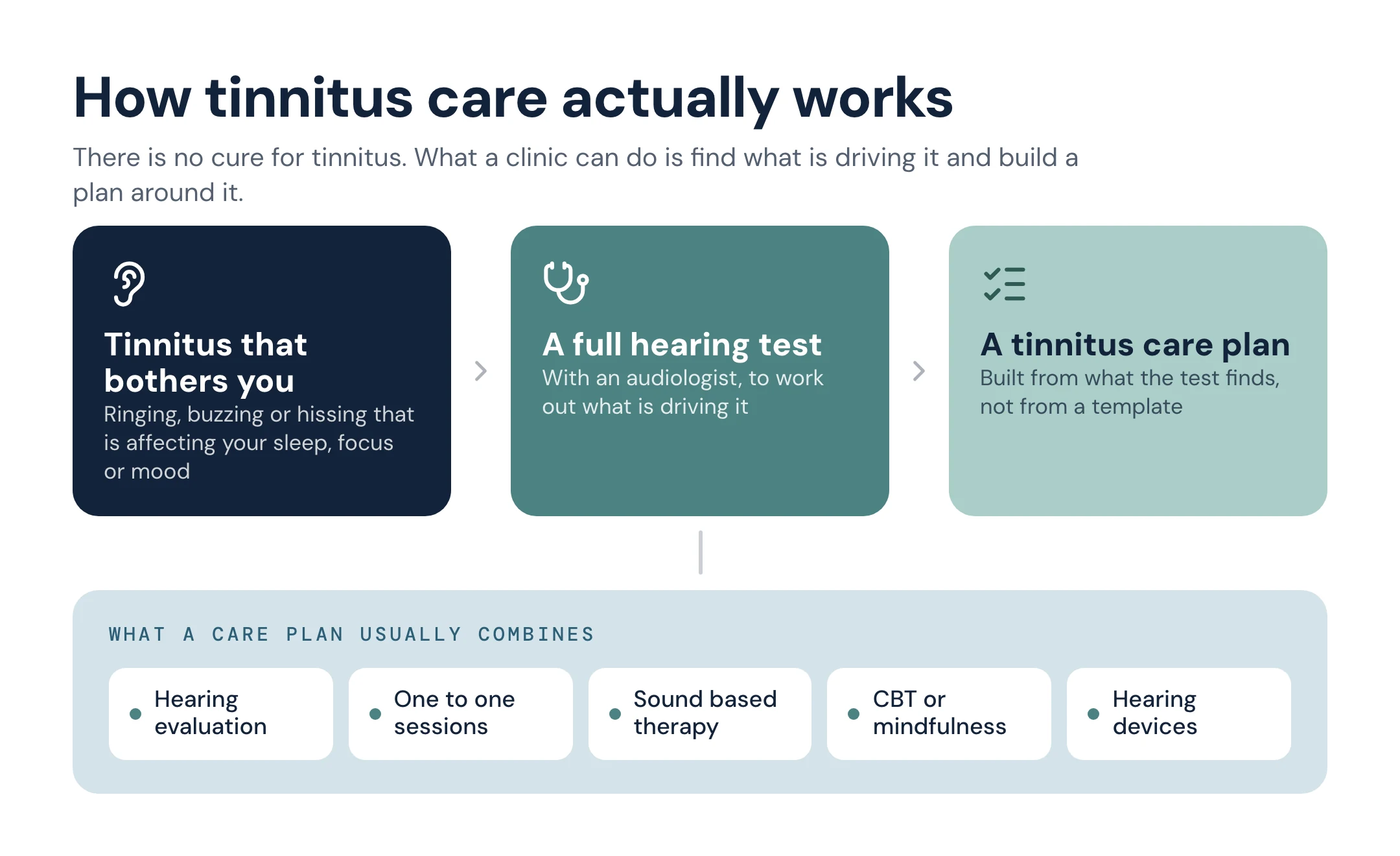
Alongside a proper hearing assessment, as one part of a plan. Current guidance puts tinnitus focused counseling and cognitive behavioral therapy first, with mindfulness as a well studied companion to them.
There is no cure for tinnitus, and a 2026 review of the field puts tinnitus focused counseling and cognitive behavioral therapy as the first line treatments, with hearing rehabilitation and treatment of jaw and neck contributors as useful additions.[10] A 2020 Cochrane review, which is an independent summary of the good quality studies on one question, found cognitive behavioral therapy may be effective in reducing the negative impact tinnitus has on quality of life, while noting there is no evidence past six months of follow up.[11]
Mindfulness and cognitive behavioral therapy overlap and pull in the same direction, and a trial designed to compare them head to head has been set up but has not yet reported.[16] A separate randomized trial found acceptance based therapy, which shares the "stop fighting it" principle, reduced tinnitus impact and sleep problems more than a sound generator based program did.[15]
US clinical guidelines recommend that anyone with persistent, bothersome tinnitus has a full hearing test with an audiologist.[12] That is worth doing before you invest months in anything, because what will help you depends on what the test finds. A tinnitus care plan from an audiology clinic may include:
- A tinnitus and hearing evaluation, to work out what is contributing
- One-to-one sessions with the audiologist
- Sound based therapy, using sound to make the tinnitus less prominent
- Cognitive behavioral therapy or a mindfulness based approach, aimed at your reaction rather than at the sound
- Hearing devices, where hearing loss is part of the picture
- A structured digital program, so the daily practice continues between appointments
This is what Oto's associated specialists do. They are audiology clinics across the US that assess tinnitus and hearing and build a plan from what they find. If you have been practicing meditation on your own and want it built into a proper tinnitus plan, that is the appointment to book.
Oto is one of those digital programs. It holds a sound library, guided audio sessions covering education, mindfulness, relaxation and coping techniques, and structured daily practice, and it was built by a team including doctors and audiologists. In the US, clinics include it in a tinnitus care plan rather than patients buying it themselves.
When should you see a professional?
Any tinnitus that bothers you is worth a hearing test. A few features need seeing promptly.
See a doctor promptly if your tinnitus:
- Came with a sudden drop in hearing. This is time critical and treated far more successfully when seen within days[13]
- Is in one ear only
- Pulses in time with your heartbeat
- Comes with dizziness, ear pain, or fluid from the ear
Talk to someone first if you are struggling with your mental health. Suicidal thoughts, severe depression, or a mental health condition that feels unmanageable all mean your primary care provider or a mental health professional is the right first call. Digital tinnitus tools are not the right starting point. You would not be unusual in needing that: a 2025 review of nine studies covering more than 900,000 people found that people with tinnitus were about twice as likely to have experienced suicidal thoughts as people without it.[18]
Oto is intended for adults 18 years and older with chronic, bothersome tinnitus.
Meditation is safe for almost everyone, and two situations call for support alongside it. If turning your attention toward the tinnitus reliably leaves you distressed, a clinician can take you through that more slowly than a web page can. And if stress or anxiety around the tinnitus is dominating your days, that is treatable in its own right, and treating it goes straight at the thing that governs how much tinnitus affects you.
Frequently asked questions
Does meditation help tinnitus?
It helps with how much tinnitus bothers you. A 2019 systematic review of seven studies covering 425 people found tinnitus distress scores fell after mindfulness based courses, and two randomized trials found mindfulness did better than relaxation training. No study shows it removes the sound.
Can meditation cure tinnitus?
No. There is no cure for tinnitus, and any product or program promising one is worth avoiding. Meditation aims at your reaction to the sound, which is the part that decides how much tinnitus affects your daily life.
How do you meditate with tinnitus?
Start with two minutes of slow breathing, five counts in and seven out, then practice attention on one thing at a time. Deliberately listening to your tinnitus, a five senses check in, mindful eating and mindful walking are four exercises that need no equipment. Expect your mind to wander, and treat noticing that as the exercise working.
Should I meditate in silence?
Most people do better starting with quiet background sound, because silence makes tinnitus stand out. Set the sound once and leave it rather than adjusting it every time the tinnitus surfaces, since one experiment linked that kind of sound control to tinnitus interfering more.
Does meditation make tinnitus louder?
It can seem louder at first, because paying attention to something makes you more aware of it, and that usually settles with practice. In the largest randomized trial, tinnitus loudness ratings came down over the eight week course in both the mindfulness group and the relaxation group.
What is mindfulness based tinnitus stress reduction?
MBTSR is an eight week course adapting standard mindfulness based stress reduction for tinnitus, run in person or online. One study of 43 people found average tinnitus severity scores moved from the severe range to the moderate range, and held there at six months, though the study had no comparison group.
Is mindfulness or CBT better for tinnitus?
Cognitive behavioral therapy has the larger evidence base, including a Cochrane review, and current guidance lists it as a first line treatment. Mindfulness based cognitive therapy has two smaller randomized trials behind it. A trial comparing them directly has been set up and has not yet published results, so today both are reasonable choices and CBT is the better evidenced of the two.
How long does it take to work?
The courses that have been studied run for eight weeks, with a weekly session and short daily practice. In the online MBTSR study, average scores had already improved substantially by three weeks. Long term effects beyond six months have not been studied.
References
- Rademaker MM, Stegeman I, Ho-Kang-You KE, et al. (2019). The Effect of Mindfulness-Based Interventions on Tinnitus Distress. A Systematic Review. Frontiers in Neurology. PMID 31736854. doi:10.3389/fneur.2019.01135
- McKenna L, Marks EM, Hallsworth CA, Schaette R (2017). Mindfulness-Based Cognitive Therapy as a Treatment for Chronic Tinnitus: A Randomized Controlled Trial. Psychotherapy and Psychosomatics. PMID 29131084. doi:10.1159/000478267
- Arif M, Sadlier M, Rajenderkumar D, et al. (2017). A randomised controlled study of mindfulness meditation versus relaxation therapy in the management of tinnitus. Journal of Laryngology and Otology. PMID 28357966. doi:10.1017/S002221511700069X
- Roland LT, Lenze EJ, Hardin FM, et al. (2015). Effects of mindfulness based stress reduction therapy on subjective bother and neural connectivity in chronic tinnitus. Otolaryngology–Head and Neck Surgery. PMID 25715350. doi:10.1177/0194599815571556
- Marks E, Smith P, McKenna L (2020). I Wasn't at War With the Noise: How Mindfulness Based Cognitive Therapy Changes Patients' Experiences of Tinnitus. Frontiers in Psychology. PMID 32362850. doi:10.3389/fpsyg.2020.00483
- Hesser H, Pereswetoff-Morath CE, Andersson G (2009). Consequences of controlling background sounds: the effect of experiential avoidance on tinnitus interference. Rehabilitation Psychology. PMID 19929119. doi:10.1037/a0017565
- Gans JJ, Holst J, Holmes C, Hudock D (2023). Healing From Home: Examination of an Online Mindfulness-Based Tinnitus Stress Reduction Course During the 2020 COVID Pandemic. American Journal of Audiology. PMID 36630269. doi:10.1044/2022_AJA-22-00063
- Wang B, Gould RL, Kumar P, et al. (2022). A Systematic Review and Meta-Analysis Exploring Effects of Third-Wave Psychological Therapies on Hearing-Related Distress, Depression, Anxiety, and Quality of Life in People With Audiological Problems. American Journal of Audiology. PMID 35549513. doi:10.1044/2022_AJA-21-00162
- Jastreboff PJ (2007). Tinnitus retraining therapy. Progress in Brain Research. PMID 17956806. doi:10.1016/S0079-6123(07)66040-3
- Vanneste S, De Ridder D, Gallus S, et al. (2026). Tinnitus. Nature Reviews Disease Primers. PMID 42168216. doi:10.1038/s41572-026-00702-0
- Fuller T, Cima R, Langguth B, et al. (2020). Cognitive behavioural therapy for tinnitus. Cochrane Database of Systematic Reviews. PMID 31912887. doi:10.1002/14651858.CD012614.pub2
- Tunkel DE, Bauer CA, Sun GH, et al. (2014). Clinical practice guideline: tinnitus. Otolaryngology–Head and Neck Surgery. PMID 25273878. doi:10.1177/0194599814545325
- Chandrasekhar SS, Tsai Do BS, Schwartz SR, et al. (2019). Clinical Practice Guideline: Sudden Hearing Loss (Update). Otolaryngology–Head and Neck Surgery. PMID 31369359. doi:10.1177/0194599819859885
- Rusch HL, Rosario M, Levison LM, et al. (2019). The effect of mindfulness meditation on sleep quality: a systematic review and meta-analysis of randomized controlled trials. Annals of the New York Academy of Sciences. PMID 30575050. doi:10.1111/nyas.13996
- Westin VZ, Schulin M, Hesser H, et al. (2011). Acceptance and commitment therapy versus tinnitus retraining therapy in the treatment of tinnitus: a randomised controlled trial. Behaviour Research and Therapy. PMID 21864830. doi:10.1016/j.brat.2011.08.001
- Rademaker MM, Stegeman I, Lieftink A, et al. (2020). MinT-trial: Mindfulness versus cognitive behavioural therapy in Tinnitus patients: protocol for a randomised controlled, non-inferiority trial. BMJ Open. PMID 32102813. doi:10.1136/bmjopen-2019-033210
- Philippot P, Nef F, Clauw L, et al. (2012). A randomized controlled trial of mindfulness-based cognitive therapy for treating tinnitus. Clinical Psychology and Psychotherapy. PMID 21567655. doi:10.1002/cpp.756
- McCray LR, Scharner MK, Nguyen SA, et al. (2025). Suicidal Ideation and Behaviors in Adults With Tinnitus: A Systematic Review and Meta-Analysis. The Laryngoscope. PMID 40066649. doi:10.1002/lary.32118