
In short: Hyperacusis means being sensitive to loud noises at levels most people find perfectly comfortable, to the point of real discomfort or pain. It is far more common than the internet suggests, it usually travels with hearing loss or tinnitus rather than appearing alone, and it responds to treatment. The causes with genuine evidence behind them are noise exposure and hearing loss, migraine, jaw joint problems, and facial nerve palsy. The most encouraging part is the treatment picture: a randomized trial of cognitive behavioral therapy for hyperacusis improved sound tolerance with benefits still there a year later, and a 2026 review of sound based therapy found consistent improvement across every study it included.
What is hyperacusis?
Hyperacusis is physical discomfort or pain when a sound reaches a loudness that most people would find perfectly tolerable.
The word covers a specific thing, and it gets mixed up with three neighbors that need different treatment. The clearest definitions come from a 2022 American review written to sort exactly this out.[1]
| Condition | What defines it |
|---|---|
| Hyperacusis | Physical discomfort or pain once any sound reaches a certain loudness that would be fine for most people |
| Misophonia | Intense emotional reactions to particular sounds, often chewing or sniffing, regardless of how loud they are |
| Noise sensitivity | Increased reactivity to a environment you perceive as noisy, including annoyance or feeling overwhelmed, regardless of loudness |
| Phonophobia | Anticipatory fear of sound, meaning anxiety and avoidance because a sound might occur |
The distinction that matters most day to day: hyperacusis is about loudness, misophonia is about which sound it is. Someone who finds a dripping tap unbearable at any volume is describing misophonia. Someone for whom a dishwasher, a car indicator or ordinary speech becomes painful once it passes a certain level is describing hyperacusis.
These conditions overlap, and people often have more than one. Our guide to misophonia treatments covers that side in more detail.
How common is hyperacusis?
Much more common than it is usually described. Depending on how it is defined and measured, studies find it in anywhere from 0.2% to 17.2% of the general population.
A 2021 scoping review pulled together 42 studies covering nearly 35,000 people across roughly 30 years of research. It found general population prevalence ranging from 0.2% to 17.2%, with the higher end in adolescents and older adults, significantly higher rates in women, and significantly higher rates in people who already have a hearing disorder.[2]
A population based study of 5,107 adults aged 45 to 70 put a firmer number on it: 15.2% reported hyperacusis. That study also found the people most likely to say it affected their daily life were those with hearing loss, mental health difficulties, or poorer physical health.[3]
Two things follow that are worth knowing if you have just been told this is rare:
- It is not rare. You will find claims that hyperacusis affects a tiny fraction of people. The published range is orders of magnitude wider than that, and the best population study puts it at roughly one adult in seven in that age group.
- It usually keeps company. Hyperacusis commonly occurs alongside tinnitus rather than instead of it,[2] which is why so many people arrive at it from a tinnitus diagnosis.
What does hyperacusis feel like?
Ordinary sound stops being background and starts being an event, and the reaction is physical rather than just annoyance.
People who are sensitive to loud noises in this way describe it fairly consistently:
- Everyday sounds seem much louder than other people find them
- A specific loudness threshold, above which sound becomes uncomfortable or genuinely painful
- Sharp sounds are worst: cutlery, dishes, children's voices, a car indicator, brakes
- Discomfort, aching or pain in or around the ear
- Flinching or wanting to cover your ears
- Avoiding restaurants, parties, cinemas and other places you used to enjoy
- Tiredness after time in a noisy environment
The avoidance is the part that quietly does the most damage, and it is also the part treatment targets most directly.
What causes hyperacusis?
Four hyperacusis causes have real evidence behind them: noise exposure and hearing loss, migraine, jaw joint problems, and facial nerve palsy.
A note on the list itself. Hyperacusis causes are often presented as a set of six, and we have removed two of them from this article after checking the literature. Lyme disease and Meniere's disease are widely repeated online as causes of hyperacusis, and we could not find research supporting either. What exists around Meniere's concerns loudness recruitment, which is abnormally fast loudness growth caused by cochlear hearing loss, and which the 2022 definitions review treats as a distinct thing from hyperacusis.[1]
Noise exposure and hearing loss
The most common route, and the mechanism is the brain turning up its own volume to compensate for what the ear stops sending.
Loud noise damages the hair cells in the cochlea, the spiral chamber in the inner ear that converts sound into nerve signals. That can happen in one event, such as an explosion or a concert, or gradually through years at a noisy job.
What follows is counterintuitive. When the cochlea sends less signal, the brain compensates by amplifying what it receives, which researchers call central gain. Animal studies of noise induced hearing loss show exactly this: the neural response from the cochlea drops sharply, while responses in the auditory cortex and the amygdala become proportionately much larger.[4] Turn the input down, and the system turns its own amplifier up. Sound that gets through then arrives louder than it should.
This is also why hyperacusis and hearing loss so often travel together, and why the treatments below work on the amplifier rather than on your ears.
Migraine
Sound sensitivity is a recognized part of migraine, and it can persist between attacks rather than only during them.
Migraine is a neurological event rather than just a bad headache, and it changes how the brain processes incoming sensation. Anyone who has retreated to a dark, silent room during a migraine has experienced the sound part of it.
A 2024 study of patients with vestibular migraine, the type that involves dizziness, found hyperacusis was common and was associated with tinnitus, anxiety and depression. Notably, it was not associated with their hearing thresholds on a standard hearing test.[5] So hyperacusis in migraine appears to be driven centrally, by how the brain handles sound, rather than by anything measurable in the ear.
If your sound sensitivity comes and goes with headaches, tell whoever manages your migraine. Treating the migraine is the lever.
Jaw joint problems (TMJ)
Jaw joint disorders produce ear symptoms including sound sensitivity, and the two sit close enough together that the connection is well documented.
The temporomandibular joint is the hinge connecting your jaw to your skull, immediately in front of the ear canal. Problems with it, usually called TMJ or TMD, are known for jaw pain, clicking and difficulty chewing. They also generate ear symptoms.
A study of 200 people found signs of temporomandibular disorder in 85% of patients with tinnitus, against 55% of controls, and reported that tinnitus was associated with jaw problems along with earache, dizziness, a stuffy sensation and hyperacusis.[6] A separate review of the relationship concluded that the correlation between temporomandibular disorders and ear symptoms holds up even where the ear itself is not the direct cause.[7]
Signs your jaw may be involved:
- Jaw pain, or pain in front of the ear
- Clicking or popping when you open your mouth
- Difficulty or discomfort chewing
- Headaches around the temples
- Symptoms that change when you move your jaw
- Teeth grinding, or waking with a tight jaw
This one is worth chasing because it is treatable through a route most people never consider for an ear problem: dental splints, physical therapy, and treating the grinding. We cover the overlap in TMJ and tinnitus.
Facial nerve palsy (Bell's palsy)
Sound sensitivity is a recognized feature of sudden facial paralysis, though the usual textbook explanation for it does not hold up well.
Bell's palsy causes sudden weakness or paralysis on one side of the face. The facial nerve also supplies the stapedius, a tiny muscle in the middle ear that tightens in response to loud sound, so the standard explanation is that the muscle stops damping sound and everything becomes too loud.
The best study on this contradicts that explanation. A research protocol following 48 consecutive patients with acute facial paralysis measured both the acoustic reflex and loudness discomfort, and concluded that hyperacusis was not related to stapedius muscle paralysis.[8] The same study found that increased sensitivity to loud sound indicated a poorer outlook for nerve recovery, so it is a sign worth reporting to whoever is treating you.
Sound sensitivity genuinely occurs with facial palsy, and the mechanism behind it is less settled than most sources imply. The literature here is old and small, so treat any confident explanation of it with some caution.
How loud is too loud?
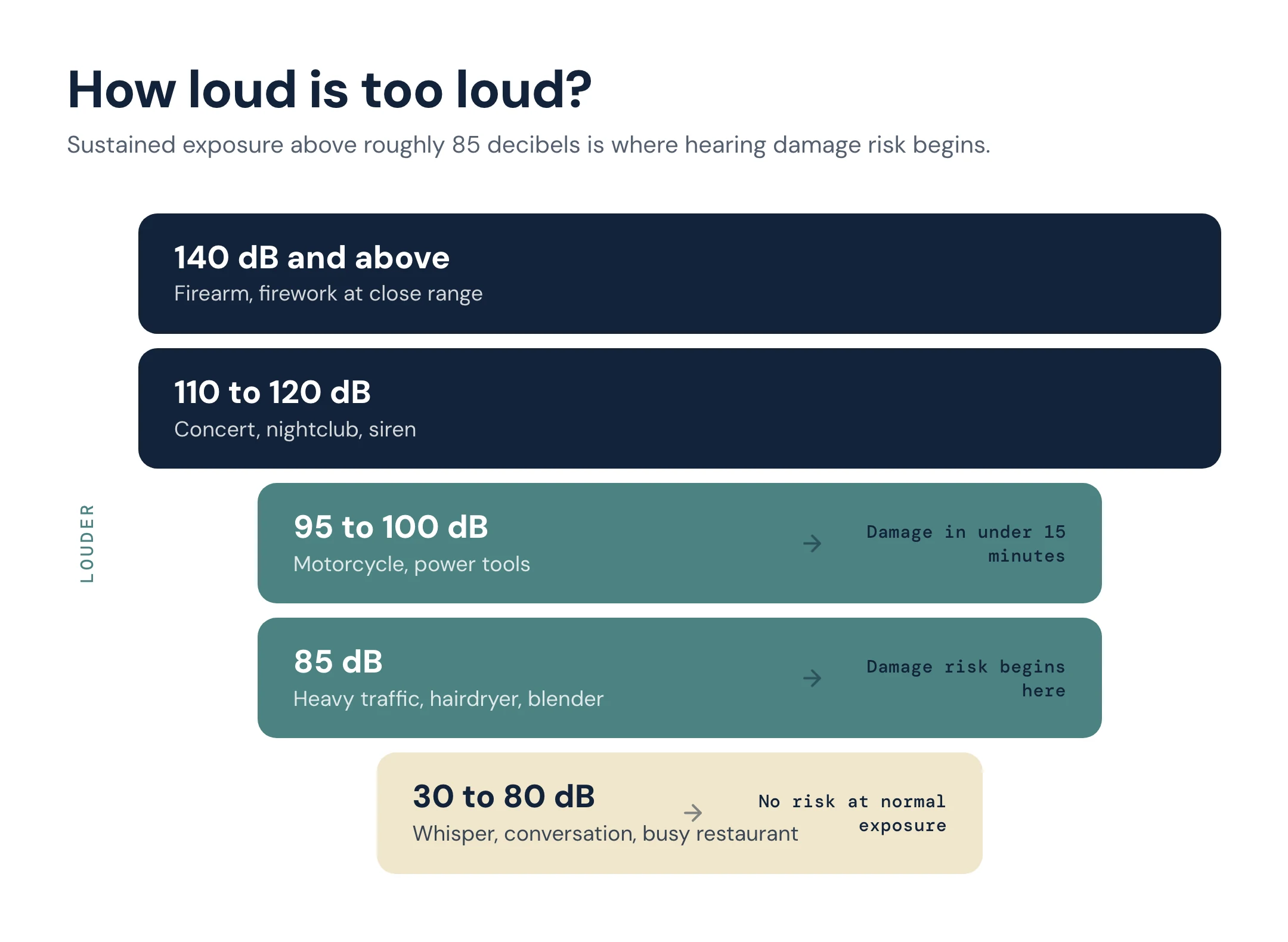
Sustained exposure above roughly 85 decibels is where hearing damage risk begins, and knowing the numbers helps you tell real risk from ordinary sound.
One of the harder parts of hyperacusis is losing your sense of which sounds are actually dangerous and which merely feel dangerous. A rough scale helps.
| Sound | Approximate level | Risk |
|---|---|---|
| Whisper, quiet library | 30 dB | None |
| Normal conversation | 60 dB | None |
| Busy restaurant, vacuum cleaner | 70 to 80 dB | None for normal exposure |
| Heavy traffic, hairdryer, blender | 85 dB | Damage possible over prolonged exposure |
| Motorcycle, power tools | 95 to 100 dB | Damage in under 15 minutes |
| Concert, nightclub, siren | 110 to 120 dB | Damage in minutes |
| Firearm, firework at close range | 140 dB+ | Immediate damage |
You can measure your own environment. The US National Institute for Occupational Safety and Health publishes a free Sound Level Meter app, and most smartwatches now record ambient noise levels and warn you above a threshold. Measuring is genuinely useful for hyperacusis, because it separates the sounds that are objectively loud from the sounds that only feel that way.
Should you wear hearing protection?
For genuinely loud environments, yes. Wearing it through ordinary daily life tends to work against you.
Earplugs and defenders make sense for concerts, power tools, motorcycling and noisy work. That is what they are for, and using them protects the hearing you have.
The picture is different for everyday sound. Treatment for hyperacusis works by gradually rebuilding your tolerance through controlled sound exposure, and current therapy programs combine that exposure with counseling and education.[9] Reviews of the underlying science describe how prolonged low level sound stimulation produces neuroplastic changes that appear to reverse the raised central gain sitting behind hyperacusis.[10] Removing everyday sound removes the thing the treatment depends on.
Most audiologists land in the same place: protect against genuinely harmful sound, use ordinary sound the rest of the time, and let a clinician guide the pace. If you are currently wearing earplugs indoors or in quiet places, raise that at your appointment rather than changing it abruptly on your own. Our guide to ear plugs for tinnitus covers the same balance.
What treatment helps hyperacusis?
Both sound based therapy and cognitive behavioral therapy have real evidence behind them, and this is the most encouraging part of the picture.
Sound based therapy. A 2026 systematic review screened 149 articles and analyzed nine quantitative studies, including three randomized controlled trials. All nine reported substantial improvement in hyperacusis symptoms after sound generator therapy, and the reviewers concluded that these interventions significantly reduced hyperacusis related disability. They also noted that the evidence base would benefit from more randomized trials.[11]
Cognitive behavioral therapy. A randomized controlled trial of 60 people with hyperacusis compared cognitive behavioral therapy, a talking therapy that works on the reactions and avoidance built up around a problem, against a waiting list. It found significant differences in favor of treatment on almost every measure, with moderate to high effect sizes, including on the objective loudness discomfort level test. The improvements were largely maintained twelve months later, and the waiting list group improved in the same way once they were treated.[12]
An uncomfortable levels assessment. An audiologist can measure the loudness at which sound becomes uncomfortable for you, which turns a subjective complaint into a number that can be tracked. It also gives you and your clinician a baseline to work from.
Treating what sits alongside it matters too. Hyperacusis travels with tinnitus, anxiety and low mood,[2] [5] and each of those makes the others harder.
When should you see an audiologist?
Any sound sensitivity that is changing what you do is worth assessing. A few things need seeing sooner.
See a clinician promptly if your sound sensitivity:
- Came on suddenly, or alongside a sudden drop in hearing
- Is in one ear only
- Comes with facial weakness or drooping, which needs same day assessment
- Comes with ear pain, discharge, or dizziness
- Arrived after a head injury or a single very loud noise event
Talk to someone first if you are struggling with your mental health. Suicidal thoughts, severe depression, or a mental health condition that feels unmanageable all mean your primary care provider or a mental health professional is the right first call. Digital tinnitus tools are not the right starting point.
And book an assessment sooner rather than later if you have started avoiding things. Avoidance is the mechanism by which hyperacusis narrows a life, and it is easier to interrupt early than to unwind after a year.
Oto is intended for adults 18 years and older with chronic, bothersome tinnitus.
What should you do next?
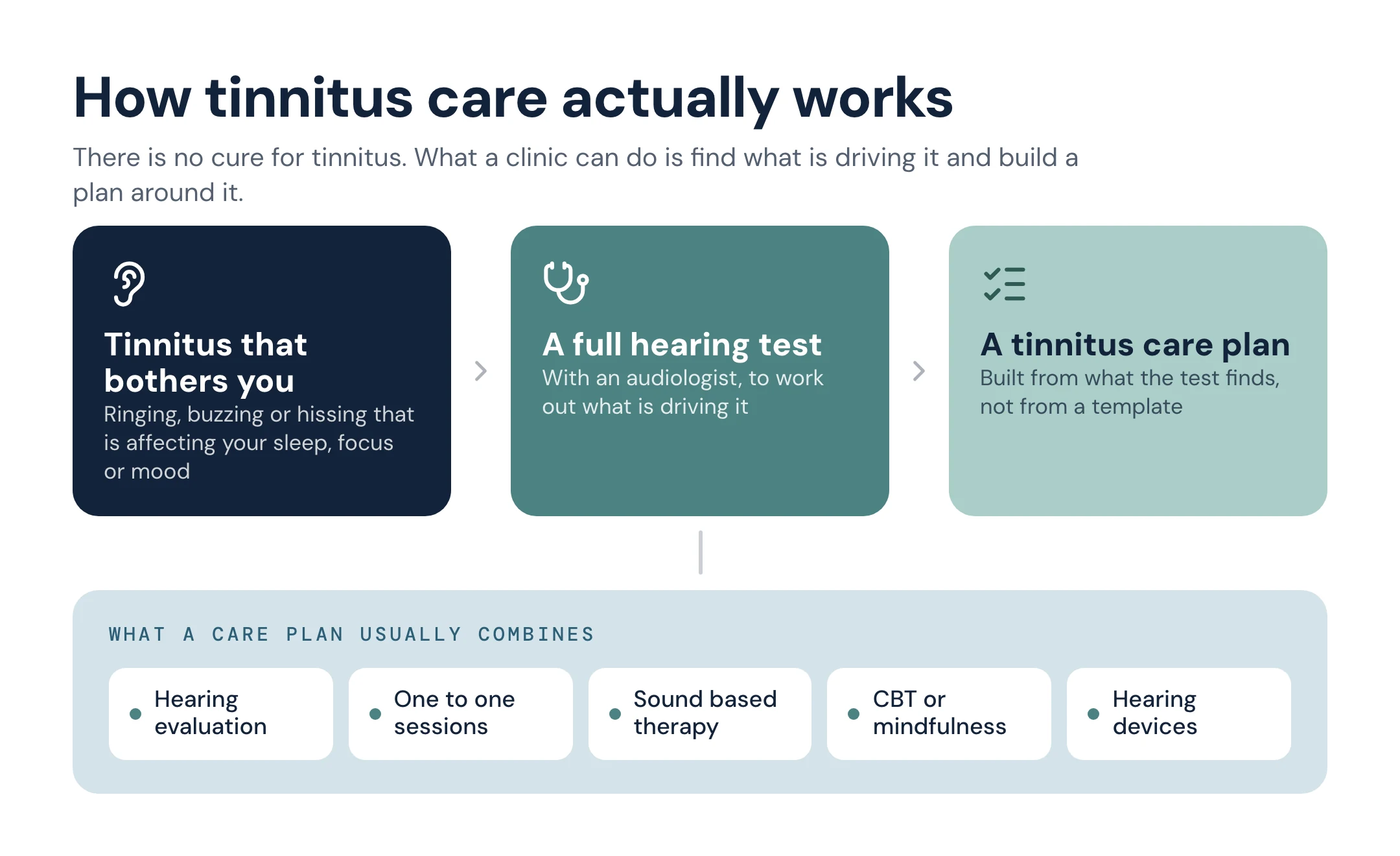
Start with a full hearing assessment, because hyperacusis rarely travels alone and the plan depends on what else is going on.
An audiologist can test your hearing, measure the level at which sound becomes uncomfortable for you, check whether tinnitus is part of the picture, and rule out the things above. That assessment is what turns a vague sound problem into a plan.
A care plan from an audiology clinic may include:
- A hearing and sound tolerance evaluation, including uncomfortable loudness levels
- One-to-one sessions with the audiologist
- Sound based therapy, using controlled sound to rebuild tolerance
- Cognitive behavioral therapy, working on the reactions and the avoidance
- Hearing devices, where hearing loss is part of the picture
- A structured digital program, so the daily work carries on between appointments
This is what Oto's associated specialists do. They are audiology clinics across the US that assess hearing and sound tolerance and build a plan from what they find. If everyday sound has started dictating where you will and will not go, that is the appointment to book.
Oto is one of those digital programs. It holds a sound library, guided audio sessions covering education, mindfulness, relaxation and coping techniques, and structured daily practice, and it was built by a team including doctors and audiologists. In the US, clinics include it in a care plan rather than patients buying it on their own.
Frequently asked questions
What causes hyperacusis?
Four causes have real evidence behind them: noise exposure and hearing loss, migraine, jaw joint disorders, and facial nerve palsy. The most common route is noise related hearing loss, where the brain raises its own internal gain to compensate for reduced input from the ear, so sound that does get through arrives too loud.
Is hyperacusis rare?
No. Published general population prevalence ranges from 0.2% to 17.2% depending on how it is defined, and a population study of adults aged 45 to 70 found 15.2% reported it. It is more common in women, more common with age, and more common in people who already have a hearing disorder.
What is the difference between hyperacusis and misophonia?
Hyperacusis is about loudness: sound becomes physically uncomfortable or painful past a certain level. Misophonia is about which sound it is, meaning an intense emotional reaction to particular sounds such as chewing, regardless of how loud they are. They often occur together and need different treatment.
Can hyperacusis be cured?
There is no cure, and there are treatments with genuine evidence behind them. A randomized trial of cognitive behavioral therapy improved sound tolerance with benefits maintained at twelve months, and a 2026 systematic review found sound generator therapy reduced hyperacusis symptoms across every study it examined.
Can TMJ cause hyperacusis?
Jaw joint disorders are associated with ear symptoms including sound sensitivity. One study found signs of temporomandibular disorder in 85% of tinnitus patients against 55% of controls, with hyperacusis among the associated symptoms. Because it is treatable through dental and physical therapy routes, it is worth investigating if you have jaw pain or clicking.
Should I wear earplugs all the time if sounds hurt?
Use protection for genuinely loud environments such as concerts and power tools. Wearing it through ordinary daily life works against you, because treatment rebuilds tolerance through controlled exposure to everyday sound. Discuss the pace with an audiologist rather than changing it abruptly.
Does hyperacusis go away?
It often improves, particularly when the underlying cause is treatable, as with migraine or a jaw disorder, and when treatment addresses the avoidance built up around sound. Sound tolerance is measurable, so progress can be tracked rather than guessed at.
References
- Henry JA, Theodoroff SM, Edmonds C, et al. (2022). Sound Tolerance Conditions (Hyperacusis, Misophonia, Noise Sensitivity, and Phonophobia): Definitions and Clinical Management. American Journal of Audiology. PMID 35858241. doi:10.1044/2022_AJA-22-00035
- Ren J, Xu T, Xiang T, et al. (2021). Prevalence of Hyperacusis in the General and Special Populations: A Scoping Review. Frontiers in Neurology. PMID 34539554. doi:10.3389/fneur.2021.706555
- Smit AL, Stegeman I, Eikelboom RH, et al. (2021). Prevalence of Hyperacusis and Its Relation to Health: The Busselton Healthy Ageing Study. The Laryngoscope. PMID 34291459. doi:10.1002/lary.29768
- Radziwon K, Auerbach BD, Ding D, et al. (2019). Noise-Induced loudness recruitment and hyperacusis: Insufficient central gain in auditory cortex and amygdala. Neuroscience. PMID 31669363. doi:10.1016/j.neuroscience.2019.09.010
- Haro-Hernandez E, Perez-Carpena P, Di Berardino F, et al. (2024). Hyperacusis and Tinnitus in Vestibular Migraine Patients. Ear and Hearing. PMID 39773900. doi:10.1097/AUD.0000000000001632
- Hilgenberg PB, Saldanha AD, Cunha CO, et al. (2012). Temporomandibular disorders, otologic symptoms and depression levels in tinnitus patients. Journal of Oral Rehabilitation. PMID 22035253. doi:10.1111/j.1365-2842.2011.02266.x
- Kusdra PM, Stechman-Neto J, Leão BLC, et al. (2018). Relationship between Otological Symptoms and TMD. International Tinnitus Journal. PMID 29993214. doi:10.5935/0946-5448.20180005
- Citron D, Adour KK (1978). Acoustic reflex and loudness discomfort in acute facial paralysis. Archives of Otolaryngology. PMID 655951. doi:10.1001/archotol.1978.00790060005001
- Theodoroff SM, Schuette A, Griest S, et al. (2024). New Hyperacusis Therapy Combines Psychoeducation, Sound Exposure, and Counseling. American Journal of Audiology. PMID 38768075
- Sheppard A, Stocking C, Ralli M, et al. (2020). A review of auditory gain, low-level noise and sound therapy for tinnitus and hyperacusis. International Journal of Audiology. PMID 31498009. doi:10.1080/14992027.2019.1660812
- Hamid NFN, Yashu MA, Bhat M, et al. (2026). A systematic review on sound-based therapy for individuals with hyperacusis. Acta Otorrinolaringológica Española. PMID 42309185. doi:10.1016/j.otoeng.2026.512375
- Jüris L, Andersson G, Larsen HC, et al. (2014). Cognitive behaviour therapy for hyperacusis: a randomized controlled trial. Behaviour Research and Therapy. PMID 24508581. doi:10.1016/j.brat.2014.01.001